Can AI find them all? - A case study on ConcreteCMS
Written by: Yonatan Drori & Daniel Goldberg
Several research groups and vendors are developing benchmarks for offensive AI agents. Like others, we evaluate our system using private test sets, public evaluations, and live Vulnerability reporting program targets.
We wanted to understand whether current AI agents could exhaustively find a defined class of vulnerabilities in a repository. Can we burn tokens and find every CSRF and IDOR? For this reason, we compared multiple agent architectures and models including AI source code security solutions like AWS Security Agent, Claude Security, Codex Security and our own Tenzai SAST agent. (Spoiler alert…) None of them are comprehensive and require careful attention to false positives and what is vulnerable in production.
We needed a codebase that is large enough to have many vulnerabilities with varied features to encourage vulnerability diversity. CMS’s (Content Management System’s) fit that profile well. They accumulate plugin systems, permissions layers - all interacting in ways that individual contributors rarely see end-to-end. The challenge is that the many prominent ones, e.g. Drupal, WordPress - have been worked over extensively by researchers, automated scanners, and increasingly AI-assisted tools.
ConcreteCMS is a content management system launched in 2008. It is written in PHP using Symfony and Doctrine ORM, and it has a granular, object-level permission system that makes it attractive to organizations that need fine-grained editorial control. We audited the most recent versions of ConcreteCMS, which, at the time, were 9.5.0 and 9.5.2.
We chose ConcreteCMS for three reasons:
- Real-world impact: a mature, well-maintained codebase used by Home Depot, the NHS, BASF, the U.S. Army, several financial and health institutions and many more
- Room to find something new: relatively little prior security research
- A clear path to fixes: a responsive disclosure program
It’s important to note that the ConcreteCMS team has been amazingly responsive under high pressure.
We reported dozens of findings to ConcreteCMS, resulting in a total of 25 unique CVEs and an additional 7 collisions. The vulnerabilities included path traversals that lead to RCE, stored XSS vulnerabilities in user and admin displays, multiple AuthN and AuthZ issues, CSRF issues, deserialization and an open redirect.
Like all developers, PortlandLabs (the team behind Concrete CMS) has dealt with a massive increase of AI generated bug-reports in the past year. Their responsiveness to these findings was exceptional. Franz Maruna, the CEO, says “"Concrete has been around long enough to have accumulated some cruft, and this research found a good chunk of it a lot faster than we've grown used to. Welcome to agentic development! I'd tell any other open source maintainer [to] make sure their triage process is robust and as automated as reasonably possible. It's a brave new world."
Evaluation
We wanted to see if we can rely on repository scanner tools to exhaust vulnerabilities in source code. Can these AI agents be relied upon to find all bugs of a specific category in a codebase. Put differently: can we rely on these tools when they report that they’re “done”?
To make this concrete (see what we did here?), we didn’t evaluate a single model or a single “security agent.” For this comparison, we compared Tenzai’s source code module (Morty) and AI SAST-style tools: Claude Security, Codex Security, AWS security agent. We performed our own manual audit of the source code.
We compared them only on findings: what each one found, what each agent missed entirely and how comprehensive were their findings. We ignore cost and time as the products differ on intended UX and cost models making these unfair comparisons.
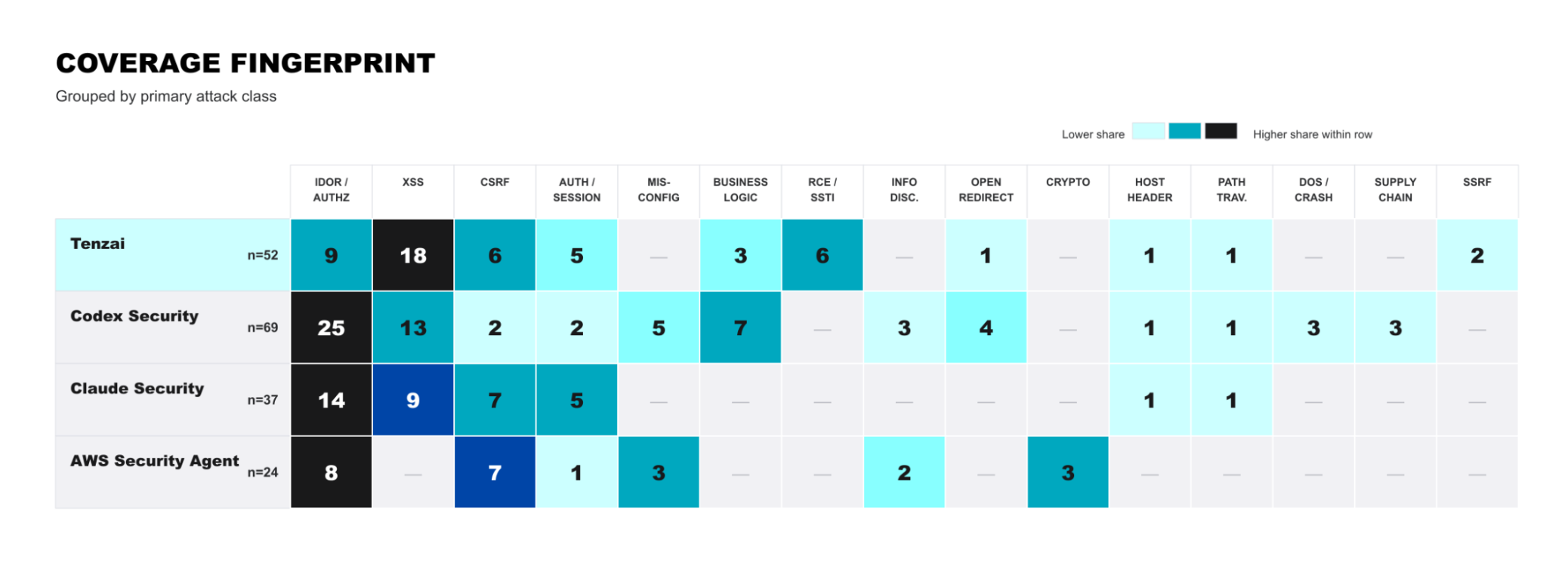
The tools produced substantially different findings. Even when pointed at the same codebase, each agent functions differently. They each approach the codebase differently, some build threat models, some deep dive and some are unknown to us. Each tool surfaced different classes of issues, such as injection sinks, authorization boundaries, business logic, cryptographic policy, and infrastructure configuration.
There was no clean overlap and we cannot state a single tool is enough to secure a repository or system.
For our analysis, our best “ground truth” is the ConcreteCMS H1 program and in cases where we decided the finding was out of scope or irrelevant to the program, expert human annotation of what findings were true or not.
For the purpose of this section, “found” means a tool that produced a report accepted by the ConcreteCMS team as a relevant security vulnerability or an expert human decided it was a correct vulnerability. The report included a specific location in code (or endpoint), with a correct root-cause explanation and enough detail to reproduce or validate the issue. When we talk about “misses,” we mean issues that were found in one scan and not in the other.
Combined findings across all tools
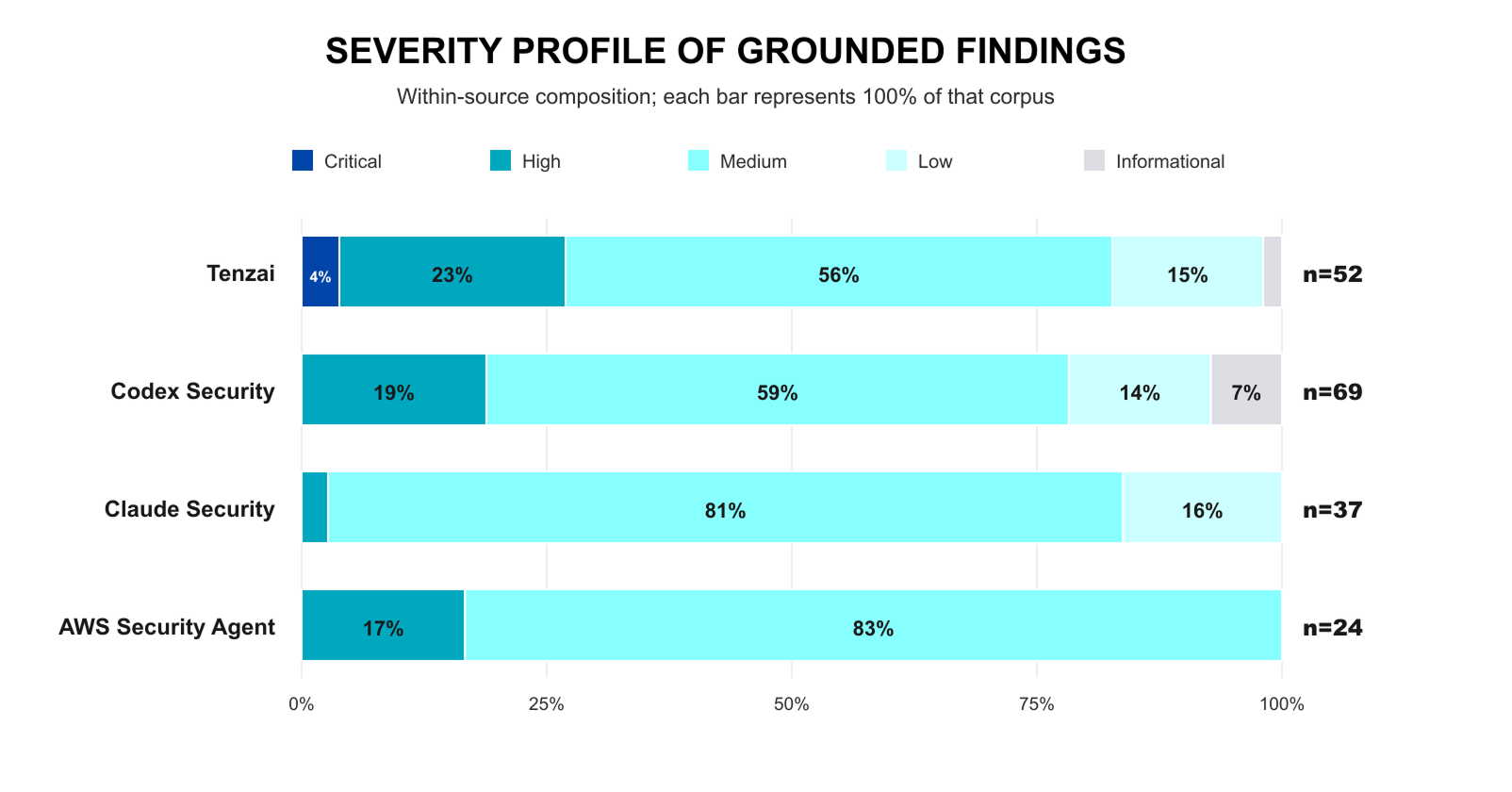
Here’s where the different agents compare as of our measurements.
Because these are all vendor hosted solutions, the agents are constantly upgraded and your results may vary.
Codex Security
13 High, 41 Medium, 10 Low, 5 Informational | Precision: ~61%
We do not know how Codex worked but looking at the vulnerabilities reported, it seems to focus on commit-introduced vulnerabilities. It reported issues per commit showing new vulnerabilities introduced in a specific commit or reactivated.
Some notable bugs found by Codex
- Stored XSS via log viewer: Express entry labels and page/calendar event names were being written into log messages and rendered through an unsafe autolink() function that constructs <a href> tags without HTML-escaping the URL. An unauthenticated public form submission could get JavaScript executing in any admin's dashboard.
- SSRF DNS-pinning bypass : checkRemoteURlsToImport caches one ValidatedRemoteUrl per hostname, not per host:port. A second import URL on the same host but a different scheme gets the wrong cURL DNS pin, bypassing private-IP protection via DNS rebinding.
- CSRF orphan cleanup - site-wide block deletion: removeOrphanedBlocks() has no CSRF token and accepts GET requests. With no usedAreas in the body, it treats every block on the page as orphaned and calls deleteBlock(true) — a global force-delete that removes block records across the entire site.
- Board instance log ACL bypass + stored XSS : a new get_instance_log() endpoint loads an Instance by ID with no permission check, and the template renders log displayData via Vue v-html with print_r() serialized content.
AWS Security Agent
4 High, 20 Medium | Precision: 96%
Thanks to public logs by the AWS security agent, we can accurately speculate on the internal design. The AWS Security Agent first understands the codebase structure, creates stock analysis covering configuration, authentication, etc. then runs many dynamically generated sub agents on cross cutting issue categories.
Some notable bugs found by AWS Security Agent
- Cryptography cluster: MD5 used for CSRF token generation and job authentication; OAuth2 RSA private key stored unencrypted in the database with no rotation mechanism; Job Runner token is a static MD5 hash transmitted in GET parameters; file download passwords stored as plaintext strings.
- Insecure defaults audit: a single consolidated finding documenting that CSP, HSTS, SameSite cookies, and brute-force protection are all false/null in the default concrete.php config. No other tool produced this.
- API authorization model gap: Users::add via the REST API bypasses the CMS permission model entirely (OAuth scope is enforced, but canAddUser() is never checked); API user creation skips the registration workflow (email validation, admin approval); authentication events are silently discarded in default installations due to a log-level mismatch (INFO logs below the NOTICE threshold).
- CSRF bypass in Express delete_entries: the token is validated but the result isn't enforced: the deletion loop runs unconditionally regardless of whether CSRF validation passed.
Tenzai / Morty
This comparison is focused on Tenzai’s SAST component nicknamed Morty. This component is responsible among other things for leads generation, creating different ideas for the rest of the platform to investigate.
2 Critical, 12 High, 29 Medium, 8 Low, 1 Informational | Precision: ~79%
Some notable bugs found by Tenzai SAST component
- Page type composer path traversal: ptComposerFormLayoutSetControlCustomTemplate accepts path traversal sequences and stores them unsanitized. When the composer dialog opens, the stored value is resolved with no directory boundary check and passed directly to PHP include. Combined with the file upload primitive — upload a PHP polyglot, traverse to it — this is full RCE from an admin session in one click. This combined with a Reflected XSS was used in our first chain, See Deep Dive #1 in the blog.
- CSRF cluster in bulk-action dialogs: Tenzai traced a full family of post-CVE-2023-48651 sibling endpoints the original patch missed: bulk log deletion, bulk page deletion, bulk page cache/design, calendar event duplication, file starring/rescanning, file version approval.
- Stored XSS in RSS feed item title: $item->getTitle() echoed with no h() while every adjacent field is escaped. Block output caching on by default; payload served to all visitors including unauthenticated for up to an hour per cycle.
- Calendar IDOR + stored XSS chain: occurrence IDs loaded without verifying calendar membership. Pivot any public calendar block to enumerate events from private calendars; the description XSS then delivers to unauthenticated users.
- OAuth authentication-bypass cluster: handleLogin() on the OAuth authorize endpoint checks only the password hash, bypassing uIsActive, uIsValidated, and uIsPasswordReset. Seven novel leads extend the surface: social-login self-registration skips public-registration controls; bound-account OAuth callbacks ignore uIsActive; deactivation never revokes existing bearer tokens; the authorize endpoint has no brute-force throttling; bearer tokens are stored verbatim in the API request-log dashboard; client-credentials endpoints accept regular user OAuth tokens; the users:add OAuth scope can mint accounts while bypassing canAddUser().
- SSTI to RCE vectors: Morty also found a LESS server-side template injection in the theme customizer - an arbitrary file read that escalates to remote code execution (CVE-2024-2961, affects environments with glibc versions <2.40), and a PHP object-injection / unsafe-deserialization sink. Together with the composer layout path traversal above, these make up the three distinct RCE/SSTI findings Morty produced.
For those interested in how we exploited these vulnerabilities and how we escalated an SSTI to an RCE, you can read our indepth report on two interesting and unique chains here Blog: From XSS to RCE - Two Exploit Chains in ConcreteCMS
Claude Security
1 High, 30 Medium, 6 Low | Precision: ~94%
We do not know how Claude Security works but we can see it also goes for a very wide category of vulnerabilities.
Some notable bugs found by Claude Security
- Bulk group assignment missing per-group authorization: any dashboard user with user-search access can upload a CSV and add themselves to the Administrators group. The controller validates CSRF and group existence but never calls canAssignGroup() on the target group. Every sibling controller does. Nobody else caught this.
- Unauthenticated file-usage dialog: dialog/file/usage.php extends the bare Controller with no authentication checks. Any anonymous request returns a list of every page embedding that file, including private and unpublished pages. This is a great example of just methodically checking everything.
Why LLMs can’t find all vulnerabilities
Every SAST agent is different in output, and they all find different types of vulnerabilities. The tools’ result sets overlapped only slightly leading us to believe that there remain many more vulnerabilities to uncover in this software.
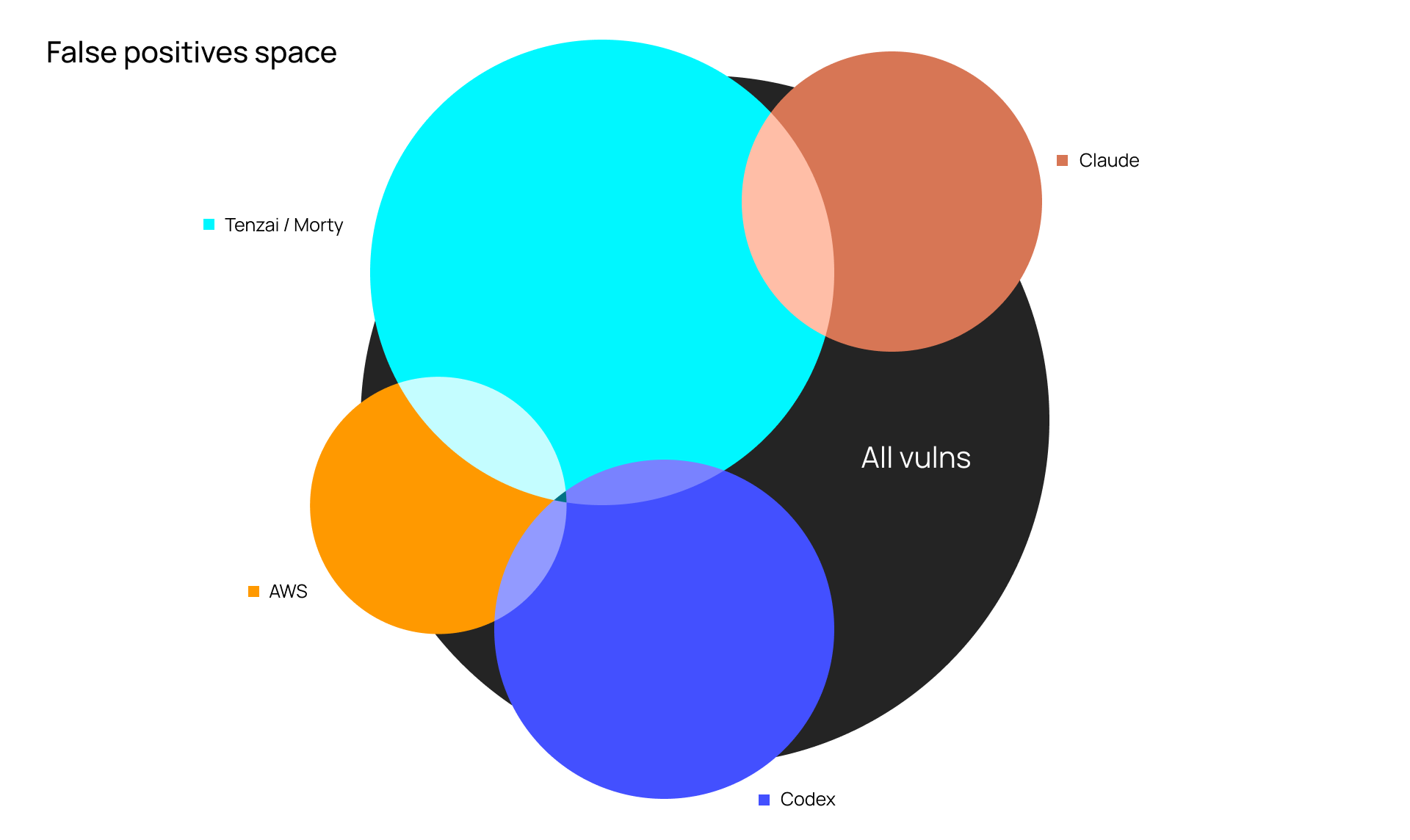
Each static-analysis agent also struggled with deployment context in different forms. Many “findings” found by the source code analysis agents were either non-existent in any real deployment or were actually by design and part of the intended functionality.
These results show that despite models' amazing vulnerability finding and exploitation abilities, they are still very limited in understanding the context in which software is deployed and used, and frequently exaggerate or misunderstand intended functionality. The gap between “there is a bug” and “there is a bug I can exploit” and “this bug matters to anyone” is large and growing larger as AI tools find more and more vulnerabilities in unused features and dead code in codebases.
Like conventional SAST tools, AI SAST findings must be validated against “prod” instances otherwise the AI can simplify/cheat its way to “validated” and “critical” findings.
At Tenzai, we use source code to spark leads, then rigorously prove exploitability against deployed environments.
Talk to us. We're listening.
See Tenzai run against an app you own.
Get a DemoMedia inquiries and interviews
[email protected]Hiring elite hackers and more
Open roles