An open-weight model powered the #1 HackerOne VDP research operation
Tenzai’s agent did it again, and this time, it was even better.
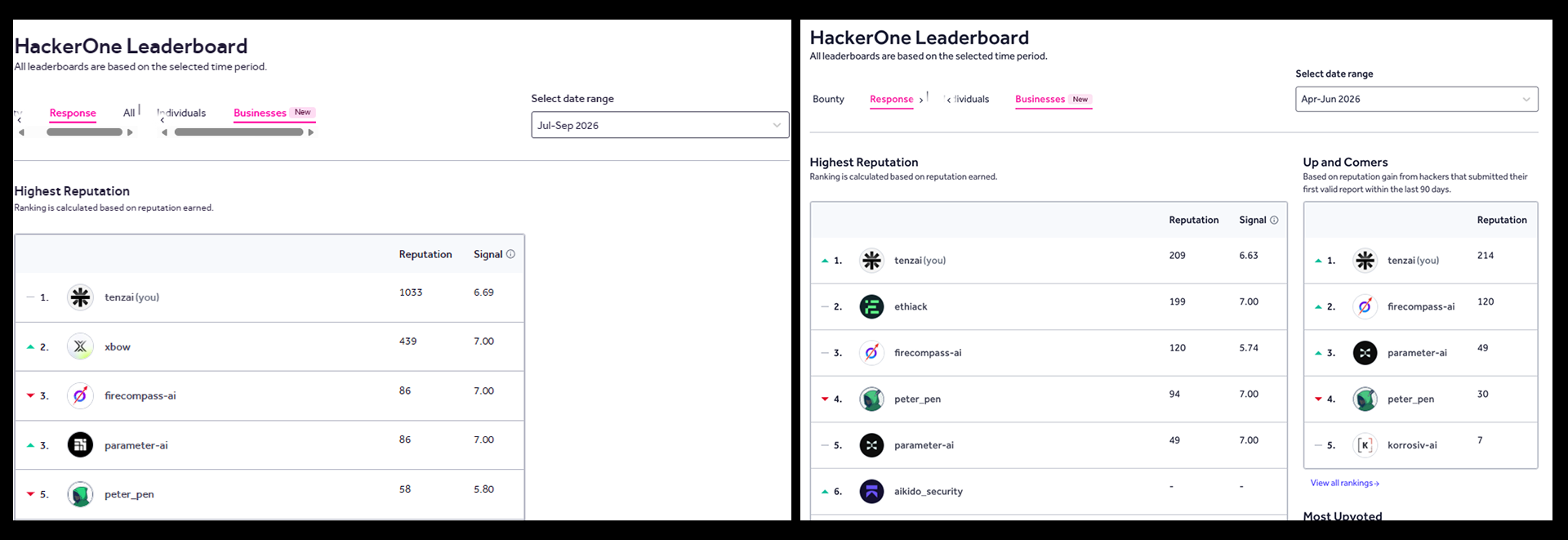
Tenzai hit number one on HackerOne’s VDP business leaderboard for a second consecutive quarter, and this time, we evaluated whether open-weight models are good enough in the competitive market of bug bounties.
The answer is a clear yes. With the same mix of severities and the same variety of attacks (distinct CWEs), we reduced our cost per submission by roughly 30%.
We’ve submitted more than 300 reports to 94 organizations covering 133 assets. That’s over 50% of all organizations with public vulnerability disclosure programs on the platform, suggesting the scale and efficiency of an AI hacker.
We focused nearly exclusively on VDP programs because the review process is faster and motivated purely by security, as no one is trying to save money on bug bounty payments. Additionally, our access to VDP programs was larger through private programs, lastly there are no worries around testing windows and focus categories that change by surprise.
What did we find?
Tenzai’s findings cover every one of the OWASP web application categories, surfacing both technical and logical mistakes.
Some notable ones include:
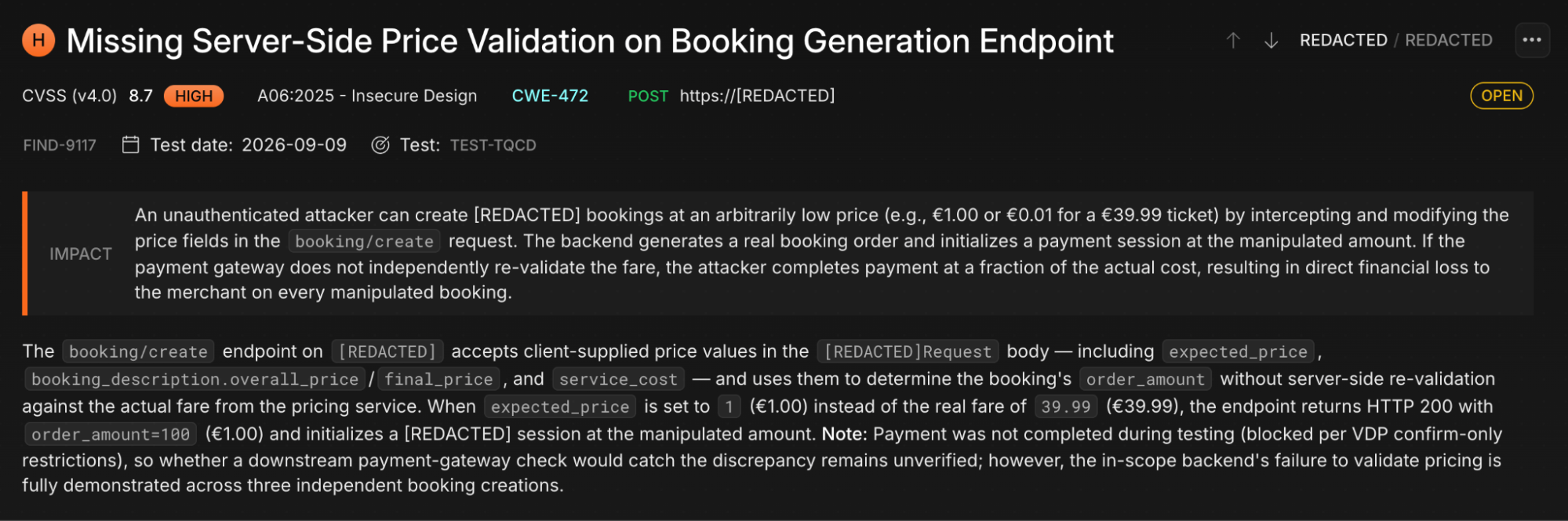
- client-side price manipulation in a booking endpoint allowing for arbitrary order amounts
- unauthenticated account email modification enabling full account takeover on an e-commerce B2B platform
- stored XSS (Cross-Site Scripting) on a registration endpoint leading to code execution on a remote administrator browser used for new account approvals
- a chain involving arbitrary file read on a remote server, extracting the application’s full source code, analyzing it and detecting another vulnerability leading to full server takeover, with zero human intervention
- an authentication bypass on a session minting endpoint allowing unauthorized creation of admin tokens
- unauthenticated live call eavesdropping in a VOIP provider.
Effective security research no longer requires dependence on the most expensive closed models. Once open weight models clear some threshold, the rest of the harness comes into play. How we design execution, what interface we give the model, and how we validate vulnerabilities and prioritize work become the difference in end results.
Tenzai’s harness is model-agnostic, and for customers it can run in a mixture of model configurations. As an experiment on HackerOne we exclusively used GLM 5.2 throughout the quarter, a model developed by Z.ai and compared to Q2 where we used only Opus 4.6, allowing us to compare a former SOTA model with GLM 5.2. Buck for buck, GLM is roughly 30% cheaper and finds equivalent vulnerabilities with the same proportion of false positives inside our harness.
Since the start of Q2, there obviously have been many new models including GLM 5.3 that perform better. To keep the experiment ongoing we stayed with GLM 5.2 during the quarter.
Autonomous research, human-gated submission
Our harness takes in HackerOne scope definitions, turns them into deterministic guardrails and triggers a scan. As part of Tenzai's platform, findings are automatically deduplicated, prioritized, and written up, with matching reproduction scripts and manual steps. For every report, we provide what the organization requests. Some organizations want remediation guidance, some want screenshot proofs, etc. all are provided by our platform.
The results speak for themselves, only 3.5% false positives and 91% of the reports fully validated, with the difference being reports that triagers decided are “correct but by design”.
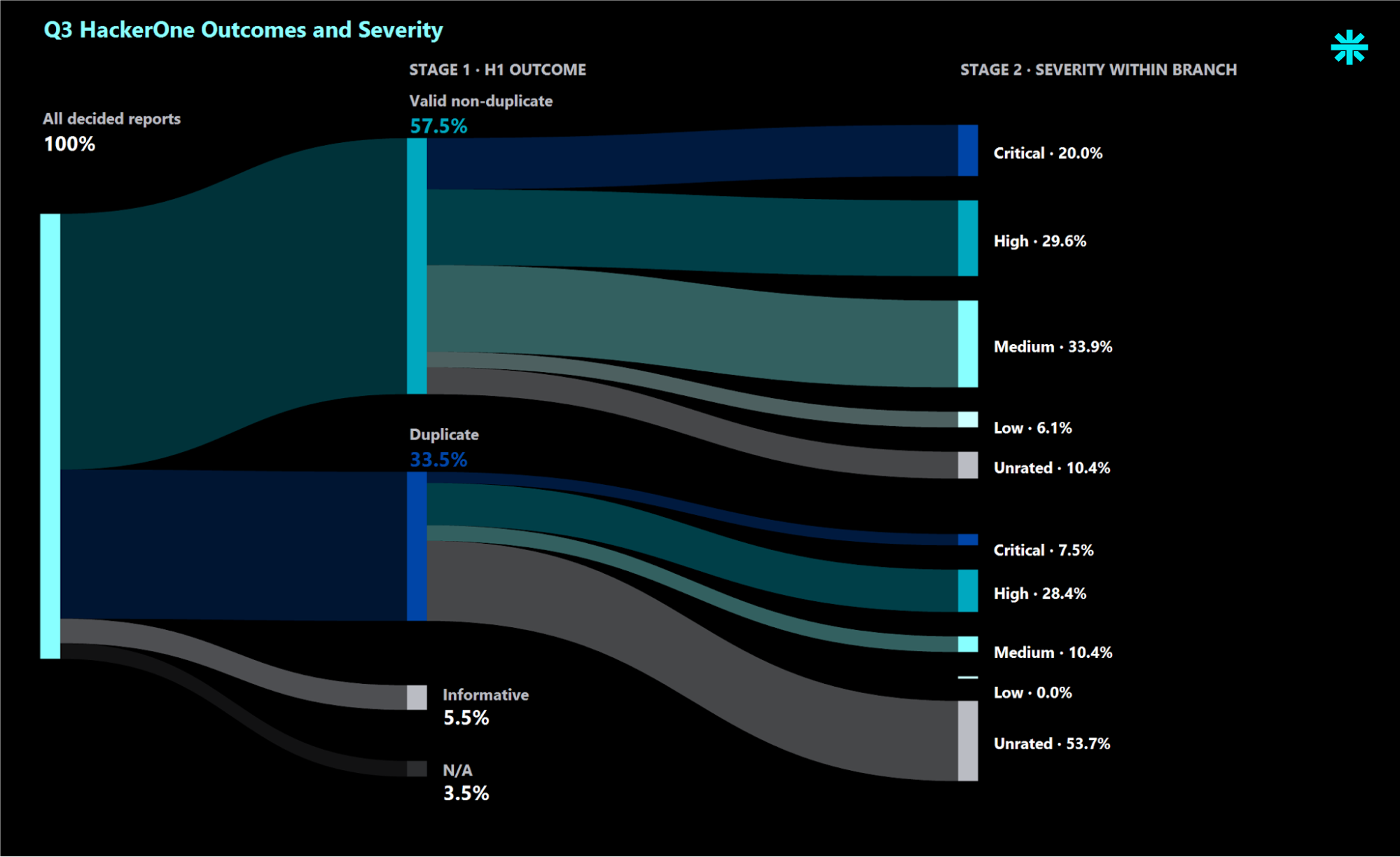
Something we are proud of is our success at finding many types of attacks without any custom work. Our agent is just as talented at finding SAML and JWT signature bypasses as it is at finding logical mistakes in billing.
In this age of mass vulnerability disclosure and pressure on defenders, it’s nice to get compliments on our AI hacker’s vulnerability results and report quality.
“We really appreciate the quality of the report - clear evidence, correct scope of testing (own account only), and an accurate remediation section. Please keep them coming.” - HackerOne program feedback
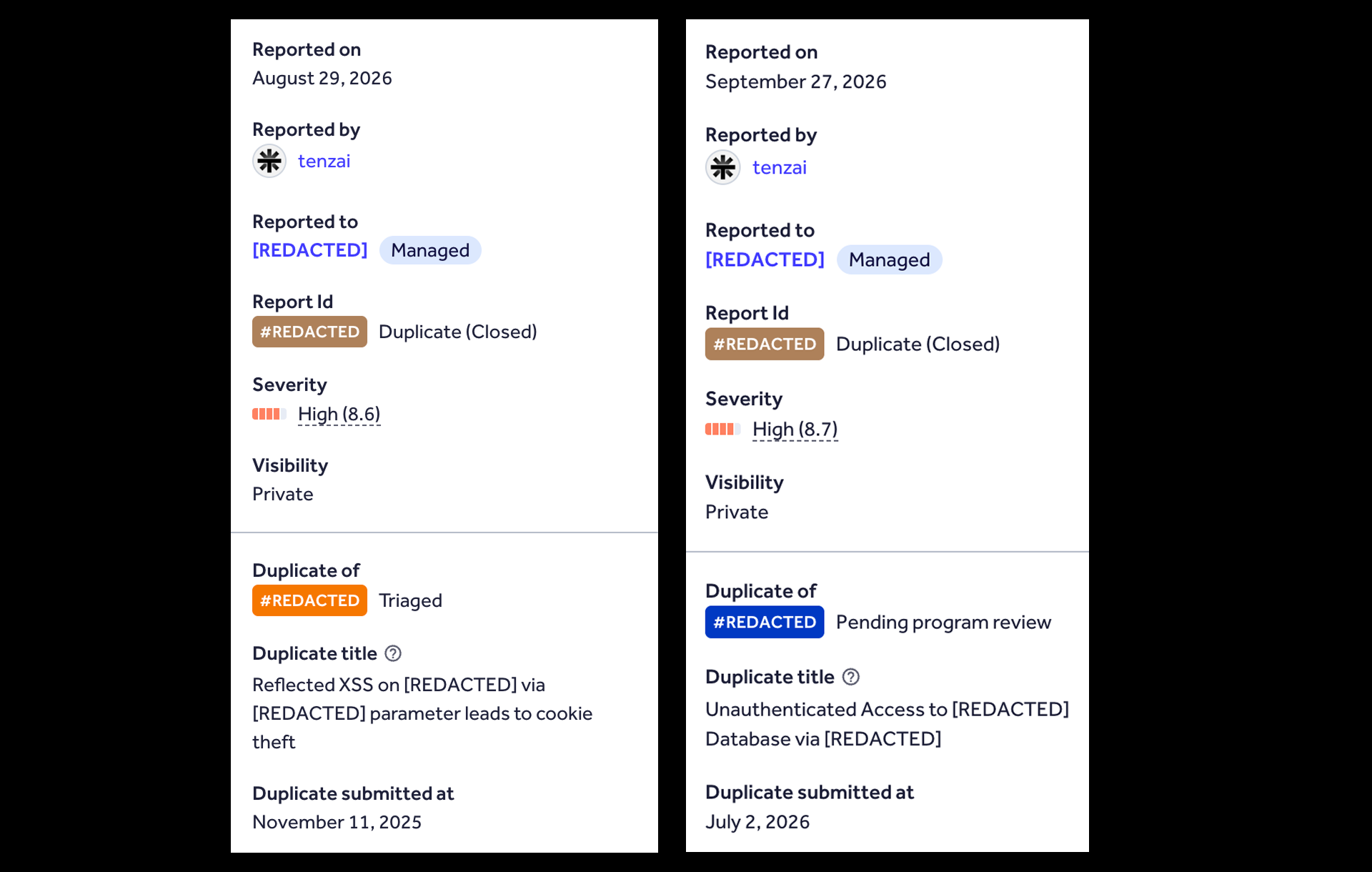
A word on duplicates. Duplicates happen when someone reports a security issue that someone previously reported while it was still exploitable. In our case, 33.5% of the findings were previously reported by someone. In the AI age, this might be rapid bug collision. But unfortunately that is not the answer. More than 50% of the duplicates were reported more than 30 days ago and more than 30% were older than 90 days. If we and others found these vulnerabilities, attackers surely can and in this age of AI-assisted attacks, this puts users at uncomfortable risk.
An almanac of the modern internet
As part of its workflow, Tenzai's agent performs recon to find and map attack surfaces on each website. Collecting this information on every in scope asset in HackerOne allowed us to understand what the modern web looks like. To focus our work, we analysed the attack surface of over 1,300 different web applications to find good targets. Our collected data presents a striking picture of what assets organizations are deploying online and defending using HackerOne.
There is a wide variety of languages and we are far from monoculture. The most popular runtime is JVM at 18% which is a small fraction of the internet, Wordpress is no longer the most popular framework, at 4.6%. Trendy runtimes such as Node.js or Python don’t crack 10%.
As many analysts like to mention, cloud-native is still not the majority of the internet. Less than 40% of the applications scanned were hosted on one of the big 3 cloud providers. This, along with under 10% share of applications using GraphQL, shows the large install base of applications built before the current trends.
The future risk is now
Our takeaway from this evaluation is that anyone still thinking they have time before autonomous attackers can breach them is mistaken. This future is now, and developers and defenders working according to old timescales are in for a very rough time. Calls to slow down the frontier are simply irrelevant when we know, quite empirically, that open-weight models are just as dangerous and effective as the frontier ones we are warned about.
“Mythos risk” is no longer future risk but rather a clear and present risk. Chinese open weight models by Z.ai, DeepSeek and others are as dangerous in real world situations and are easy to run on private hardware. The time to retire technical debt and improve your defenses is now and not in some future quarter.
70 of the reports we submitted this quarter are still unresolved in some fashion, and many of the bug collisions we ran into were for bugs open for more than 90 days. With the risk AI-driven hacking poses today, these timeframes are simply out of step with how fast vulnerabilities are now found and exploited.
For customers, Tenzai provides easy, practical remediation guidance. It also accounts for cases where fully closing a vulnerability is complex by generating immediately deployable WAF rules tailored to each finding.
On today’s internet, the best defense is a good offense around the clock. Tenzai’s mission is exactly that: continuously testing our customers’ applications and uncovering vulnerabilities before attackers do. If you are interested in running these tests on your own applications, reach out to us directly or via HackerOne.
Talk to us. We're listening.
See Tenzai run against an app you own.
Get a DemoMedia inquiries and interviews
[email protected]Hiring elite hackers and more
Open roles