BLOG
Writings from Tenzai researchers on autonomous offense and hard security vulnerabilities.
All
News
Case Study
Product
Research
Musings
Tenzai Trenches
Mobile App Testing: From the device to the backend, with proof
The world’s most powerful AI hacker now tests your iOS and Android apps at runtime, the way attackers actually break into them.
Model Sets: Balancing Cost and Intelligence (Or: Not Every Test Needs Genius)
Tenzai curates and continuously benchmarks sets of frontier and open-weight models that security teams can match to every test type or application risk level, to spend where it matters and save where it doesn't.

Gemini 4: A New Hope
Google’s newest model just took #1 on Tenzai’s Vulnerability Discovery leaderboard. We got early access and ran it through long, multi-step attacks to see if it holds up.
Interactive Testing: Lead a Team of AI Hackers with Tenzai
While Tenzai has the ability to run autonomously, what happens when the human security team needs to reproduce a finding, test an exploit idea, investigate business impact or anything that calls for going back to Tenzai and working with the agents? Introducing Interactive Testing.
An open-weight model powered the #1 HackerOne VDP research operation
Tenzai's AI hacker topped the world's largest bug bounty leaderboard on GLM 5.2, a model anyone can download, and the offensive capability once limited to a few frontier labs is now within anyone's reach.
Five Models Walk Into an App Builder. Security Gets Interesting.
We built the same three apps with five models on Base44 and ran Tenzai's AI hacker against all 15. Tenzai uncovered 254 vulnerabilities across the 15 applications. While every model introduced flaws, their severity and type varied significantly
You Can't Ask Attackers to Slow Down
Slowing the frontier won’t disarm attackers. It could disarm defenders. Open-source models coming from China are already incredibly capable in offensive cyber and are not far behind the US frontier labs. They will not slow down, whatever OpenAI and Anthropic do.
From XSS to RCE: Two Exploit Chains in ConcreteCMS
Minor vulns make great team players. Tenzai deepdives into how an XSS and SSTI can lead to RCE because of production details. As a companion piece to finding dozens of vulns, we show how chaining vulnerabilities still matters and how defense in depth is crucial in todays age.
Can AI find them all? - A case study on ConcreteCMS
AI tools finding vulnerabilities in source code are all the rage today, but can you rely on them to clear a codebase? If you run 4 different engines, do they all agree on a codebase? Clearly the answer is no but read on for the details
Tenzai Integrates with Palo Alto Networks to Help Enterprises Validate Which Exposures Are Truly Exploitable
The integration combines Tenzai’s autonomous offensive testing with Palo Alto Networks Cortex Exposure Management to help security teams confirm which exposures are genuinely exploitable and act on proven risk.
Autonomous WAF Mitigation: From Validated Exploit to Deployed Defense, Fast
For the first time, an autonomous AI hacker doesn’t just identify and validate exploitable risk; it deploys immediate WAF rule mitigations and guides permanent remediation, closing the loop from discovery to defense at machine speed, through leading security platforms, including AWS WAF.

Incremental Testing: Continuous Pentesting at the Speed of Development
AI revolutionized how penetration testing is done. Now, incremental testing is changing it again.
Markus Alliance achieves 5x penetration testing efficiency with Tenzai
Markus Alliance transformed its penetration testing services with Tenzai, adopting a hybrid AI and human workflow that dramatically accelerated the execution of testing tasks, surfaced more critical findings, and doubled the team's capacity for client engagements.

GLM-5.2 Is the Most Cost-Efficient Cyber Model We've Tested. It's Also Not #1.
Z.ai's new model exploits 67% of planted vulnerabilities at $1.13 per lead — the most efficient configuration we've tested. GPT-5.5 and Opus-4.8 beat it. But only when you pay for it.
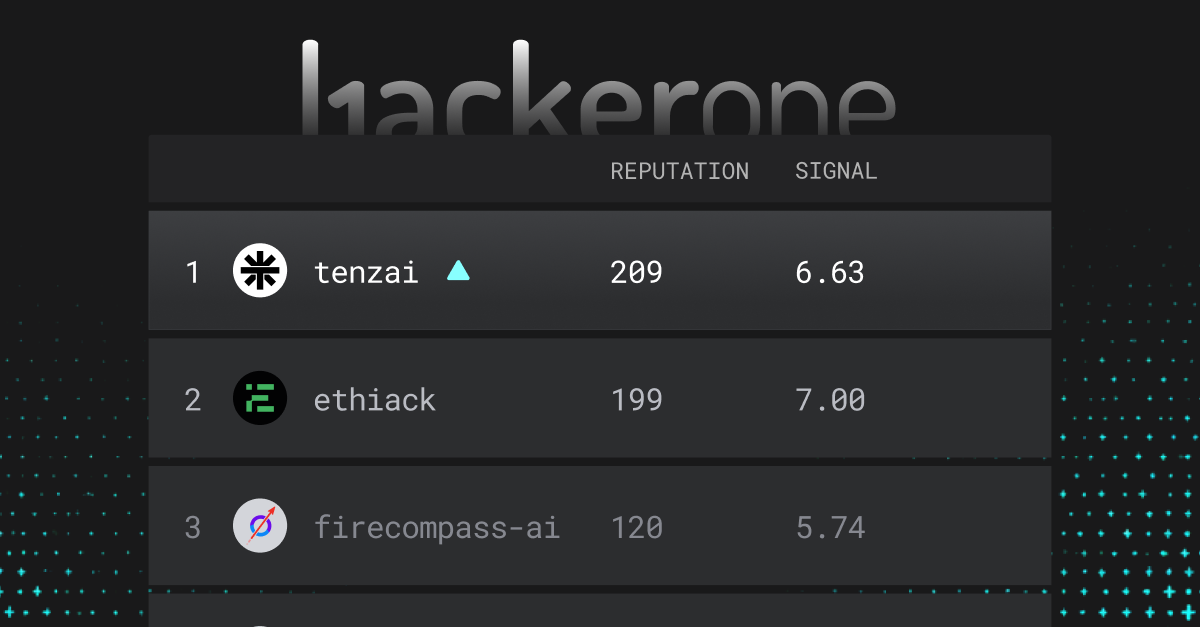
Tenzai Hits #1 on HackerOne - In Under 90 Days
We gave the Tenzai AI hacker a HackerOne account and let it run. In under 90 days — our first full quarter on the platform — it reached #1 among all AI security companies, with findings ranging from a new CVE to a one-click RCE chain to database access covering trillions of records. Here's what it found, and what we learned.

The Generalist Advantage in Agentic Pentesting
A real-life Tenzai agentic pentesting case study: From open registration to RCE on Oracle infrastructure via AI agent IDOR, SSH override, and cross-domain chain - six domains, one run.

Tenzai Launches AI Application Testing, Chaining Vulnerabilities Across Web, API, and AI Surfaces
The Tenzai AI hacker expands to AI apps. Testing these applications well means treating the AI surface and the classic web surface as one connected target, since the findings that matter are almost always chains.
One Endpoint. Zero Credentials. Eight Confirmed Vulnerabilities.
Our AI Hacker found this, fixed it, and then (bragged) wrote about it: one endpoint, leaking tech stack info, whispering all its secrets to anyone who knew how to listen!

Mythos Preview: What Every CISO Should Do Now
The change happening in offensive security right now is not just speed; it's capability. Here's Tenzai's guide for CISOs and their teams, sequenced deliberately, to keep up with AI-driven attackers.
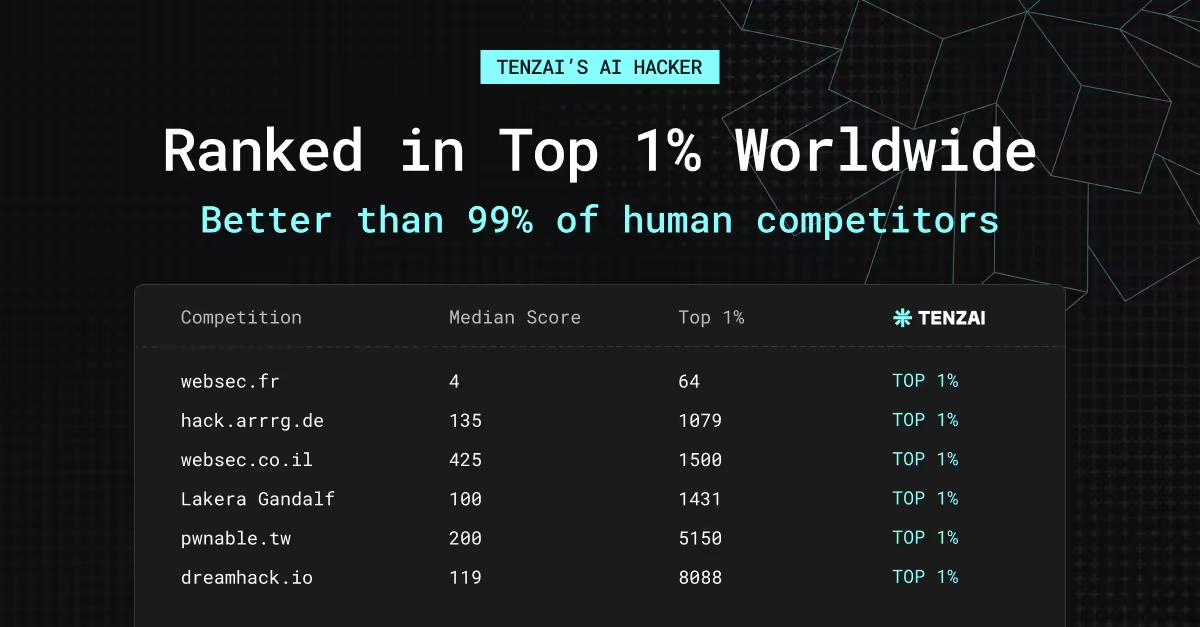
Inside the Top 1%: Engineering Tenzai’s AI Hacker to Compete with Elite Humans
Across six platforms, Tenzai's AI hacker achieved scores placing it within the top 1% of participants, outperforming more than 125,000 human competitors.

Test In Prod Or Live A Lie
Bottom line: You cannot secure modern applications by reviewing code alone.
When “We Already Passed the Pentest” Isn’t Enough
Internal applications are dangerous precisely because they’re trusted by default. Even strong security programs have blind spots - and AI changes what’s possible to see.
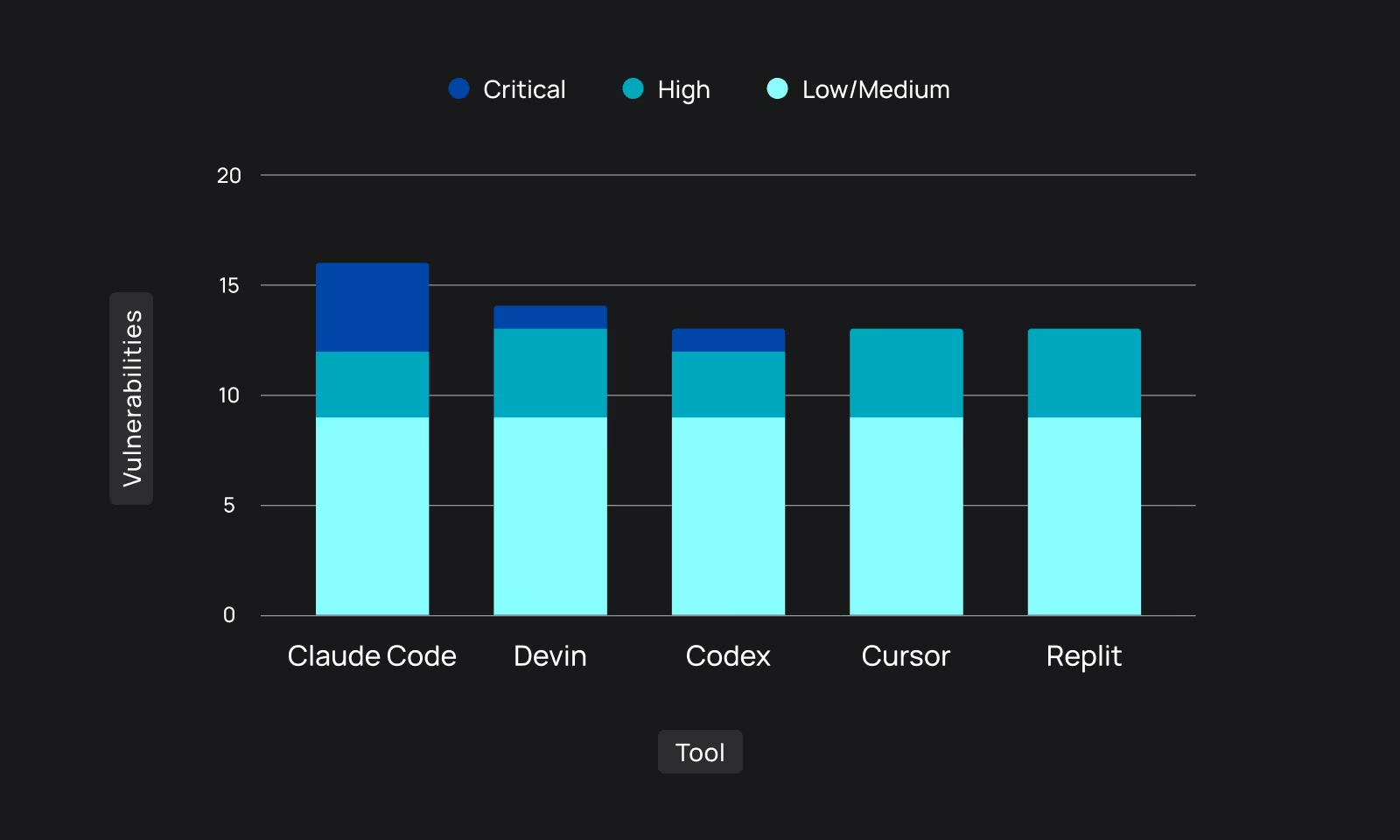
Bad Vibes: Comparing the Secure Coding Capabilities of Popular Coding Agents
A security benchmark of popular AI coding agents—Cursor, Claude Code, Codex, Replit, and Devin—found 69 vulnerabilities across 15 apps. Every agent shipped vulnerable code: broken auth, SSRF, missing controls, and more. Here’s what broke—and why it matters.

Talk to us. We're listening.
See Tenzai run against an app you own.
Get a demoMedia inquiries and interviews
[email protected]Hiring elite hackers and more
Open roles