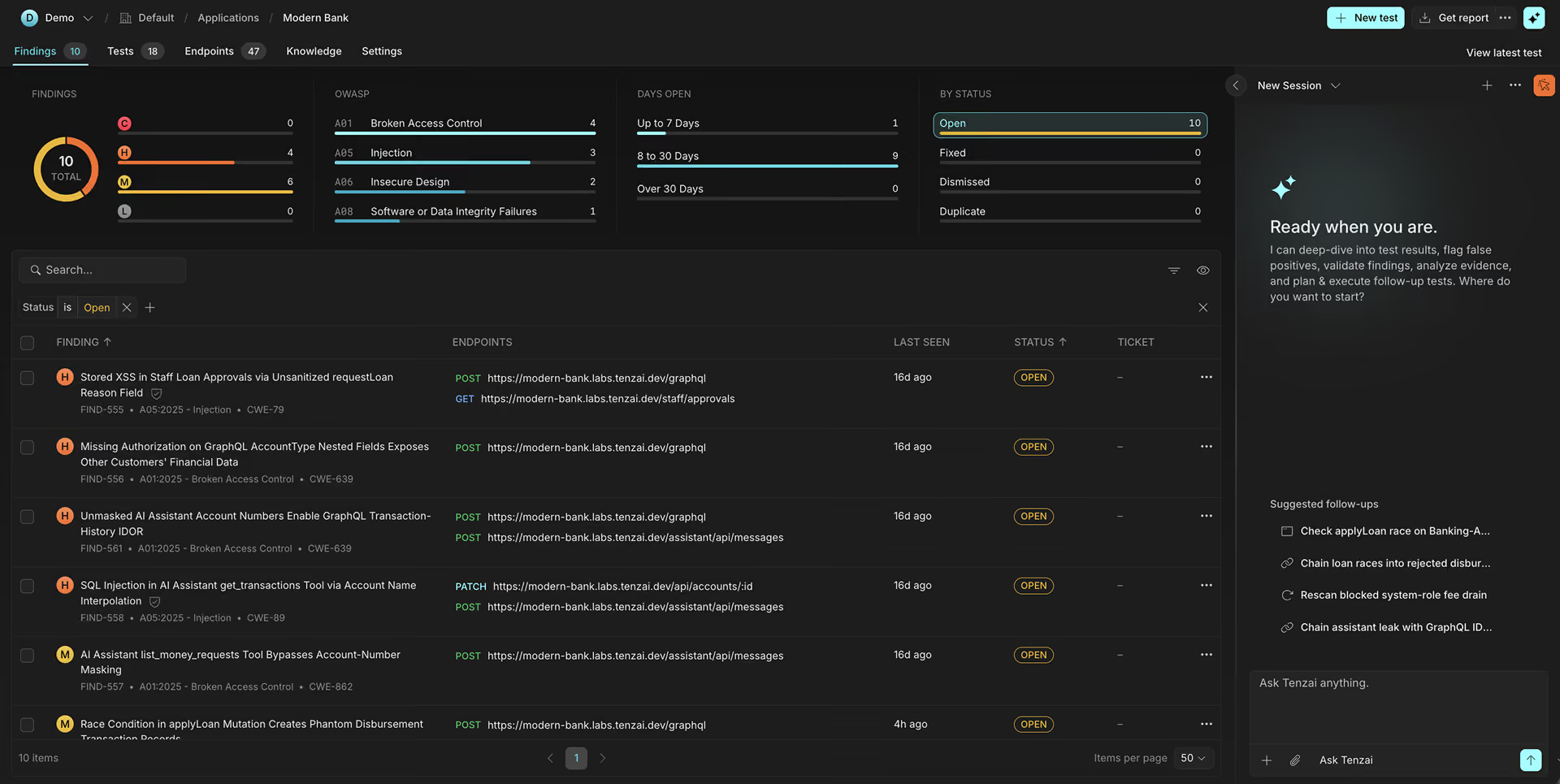
Tenzai Launches Host-Based Mitigation
Coding agents fix security issues in code, but release cycles mean a code fix can take weeks to ship. When a vulnerability is being exploited now, you need a faster option.
Today, we’re announcing that Tenzai can fix what it finds directly on the host as well: Tenzai's host-based mitigation.
This means that the most powerful AI hacker will now fix what it finds directly on the servers, VMs, and containers running your vulnerable applications - not just propose a code fix or block traffic in front of it.
A more systematic view of mitigation
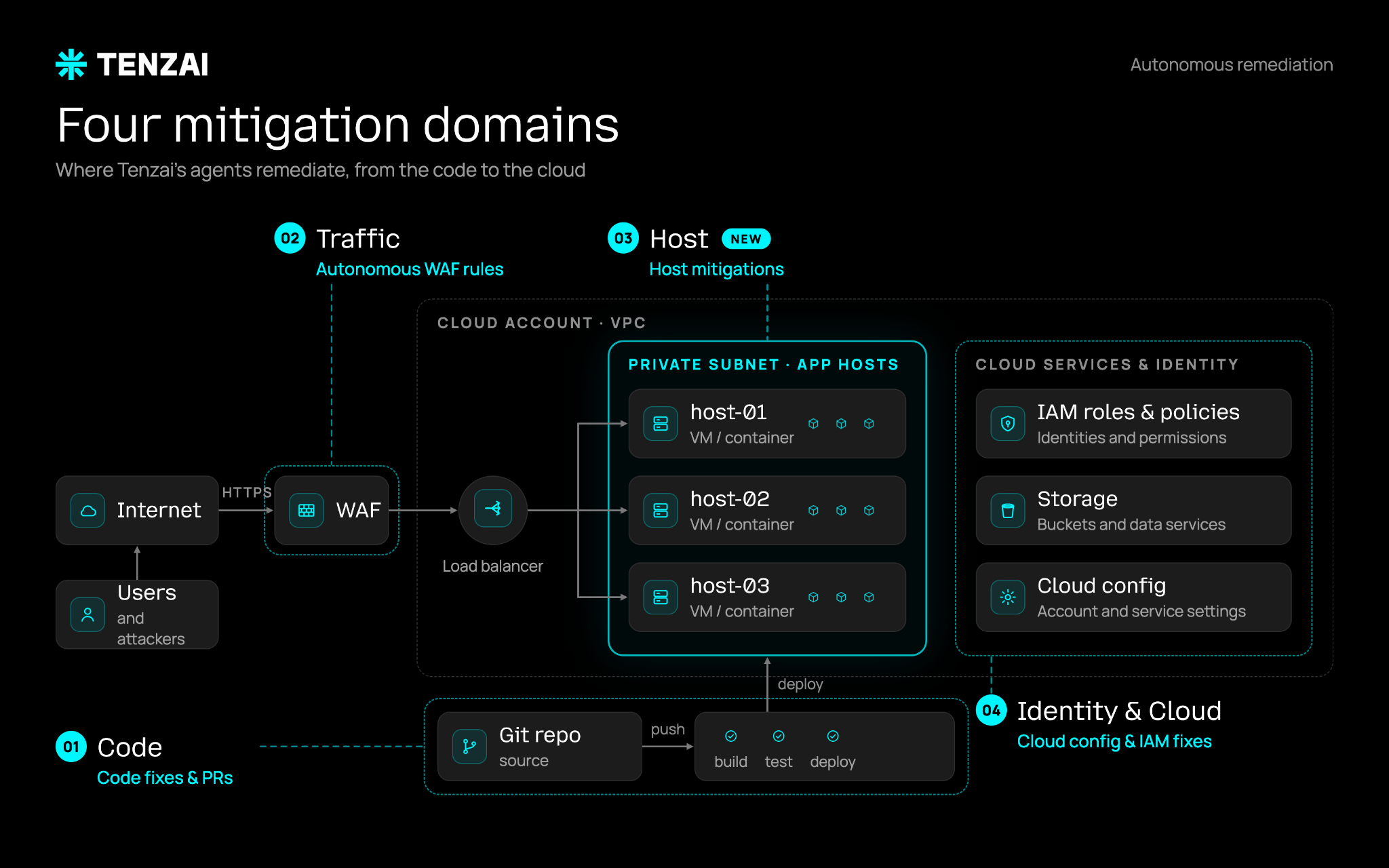
At Tenzai, we look at remediation as a system, not a single tool. When our agents prove a vulnerability is exploitable, there are four domains where we can break the attack:
- Code: Fix the root cause in the application or its dependencies. (Recommendations on how to fix are already available in production).
- Traffic (WAF): Use traffic controls such as WAF rules to stop the malicious request before it reaches the application. Tenzai already ships autonomous WAF mitigation.
- Host: Change the system that runs the vulnerable software so the attack fails or does no harm. (Launching today!)
- Identity & cloud configuration: Fix cloud configuration and identity problems, such as exposed storage buckets or over-privileged cloud identities. (Stay tuned).
Tenzai already covers the first two domains: our agents propose code fixes and deploy autonomous WAF rules. Now we're expanding to the third: the host.
Host mitigation
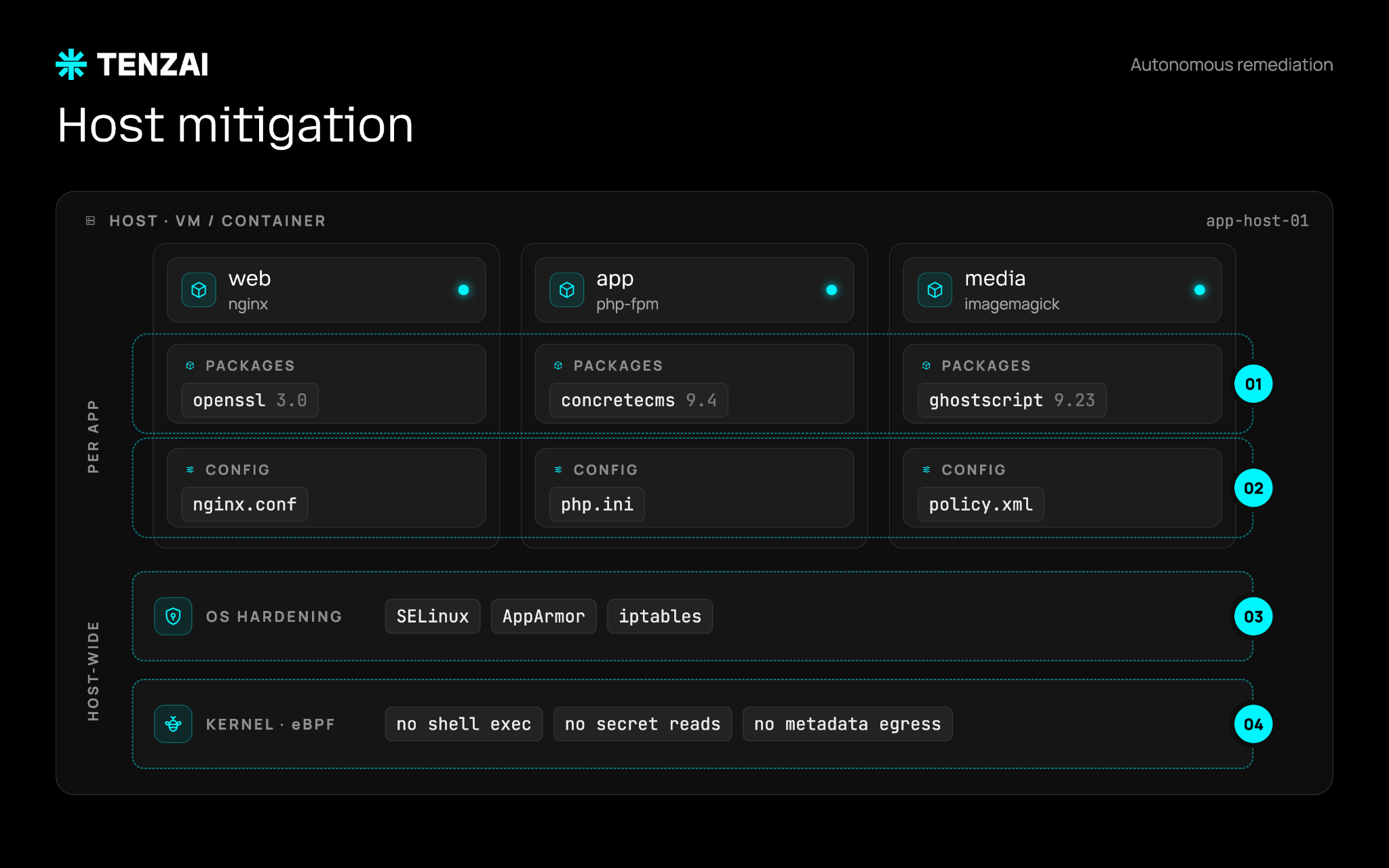
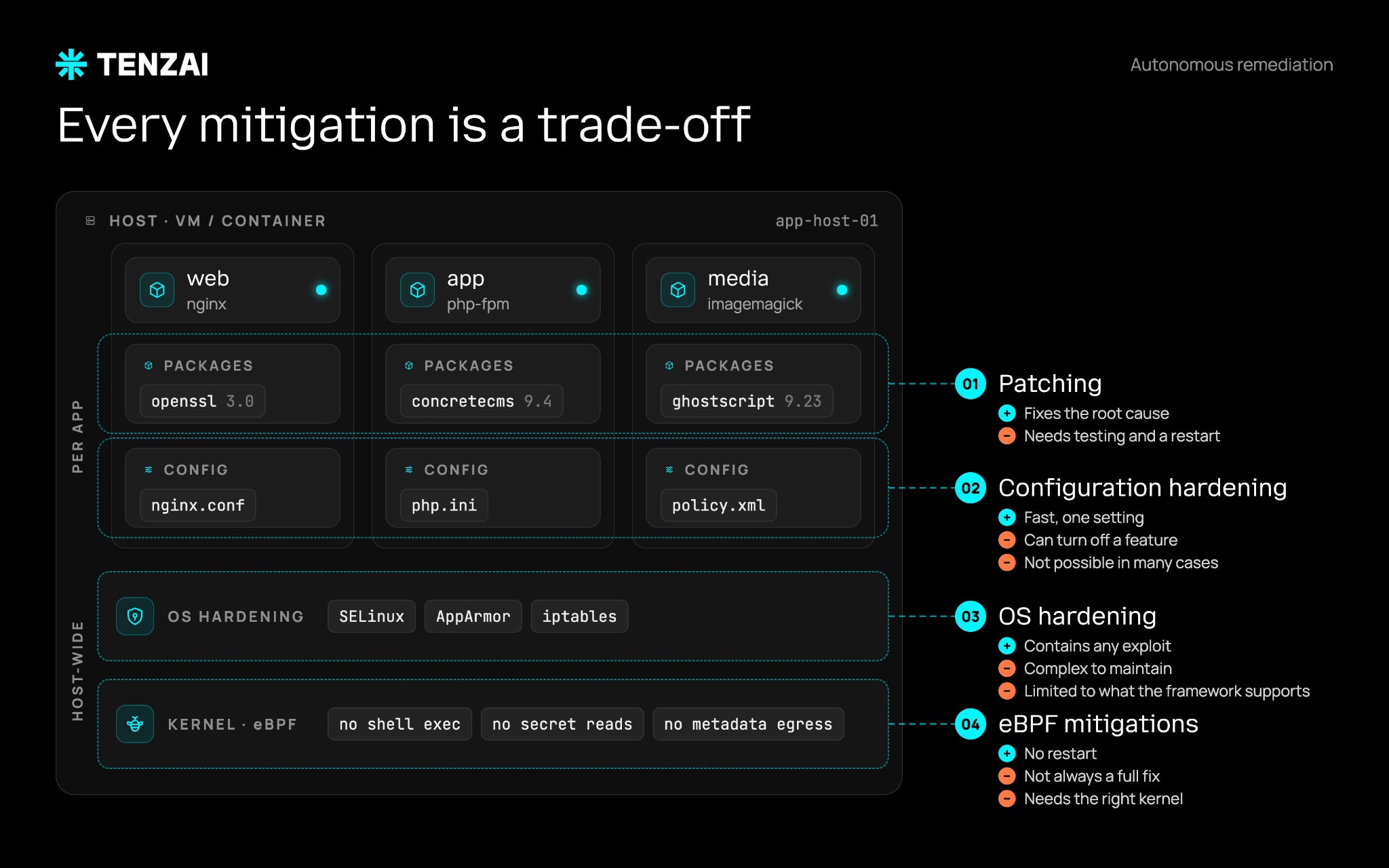
The host is where the vulnerable software actually runs, so it's also a place to stop the attack, even when the code can't change yet. Each type of host mitigation acts on a different layer, from a single app's packages and configuration down to the kernel.
On a host, there are four categories of mitigation:
- Patching. Patch or upgrade the vulnerable package or library. This fixes the root cause, but it may need compatibility testing, a restart or a maintenance window.
- Configuration hardening. Change how the system or process is configured to close the path: turn on authentication, disable an unneeded feature or protocol, tighten limits.
- OS hardening. Use SELinux, AppArmor or similar mandatory access controls to confine the vulnerable process, so that even if the bug is triggered, the attacker can't turn it into impact.
- eBPF mitigations. Using Tetragon, attach a targeted, ad-hoc runtime policy that addresses the specific weakness the exploit relies on: a system call it needs, a file it reads, a connection it opens, or a resource it abuses.
Why now?
Finding a vulnerability doesn't mean you can patch it tomorrow. Testing and rolling out a fix can take days or weeks, and attackers don't wait. Teams need ways to cut real risk in the meantime.
We've been thinking about host mitigation for a while. Since we first built remediation into Tenzai earlier this year, with code fixes and WAF rules, our agents' recommendations kept pointing at the host: upgrade a library, add a host firewall rule, turn on authentication in a service's configuration, confine a process with AppArmor or something similar.
We arrived at this conclusion the same way we arrive at most product decisions: by analyzing thousands of real exploitation paths our agents found in customer environments. The pattern was consistent enough that host-level mitigation became an obvious next layer to build.
OpenAI and Cisco reached the same conclusion independently. Their Shirudo project - an open-source runtime that generates targeted "shields" for running Linux systems while patches are still on the way - validates the same approach: when you can't patch today, you deploy something small and precise that blocks the behavior the vulnerability depends on, and the service keeps running. In OpenAI's demo, a shield generated with Codex blocked a Java4Shell exploit against a live Elasticsearch service by adding an input check to Java's Base64 decoder, without a restart.
Side note: Why Tetragon? For eBPF, we made the same call as OpenAI but chose a different platform: Tetragon, the open-source eBPF runtime since 2022 has an active community, and is the basis of Cisco's Live Protect. It runs on the kernels hosts already have, and policies load at runtime - no restart required. This makes it a much more practical solution defenders can use now.
Shirudo, which Isovalent describes as a rewrite of Tetragon for agents, currently requires a bpf-next kernel and an authenticated boot chain. Adopting it today means a new kernel and a reboot. If Shirudo gains adoption and is already installed on a host, our agent will be able to suggest fixes based on it. For now, Tetragon is the right foundation.
Choosing the right tradeoff
For almost any vulnerability, there's more than one way to mitigate it on the host, and no option is free. Patching fixes the root cause, but it may need compatibility testing, a rollout window and a restart. Configuration hardening is fast, but it can turn off a feature the service relies on. OS hardening contains any exploit of the process, but the profile has to be built and tested first. An eBPF mitigation loads at runtime with no restart, but it targets one exploit's behavior and has to be tuned so legitimate calls keep working.
The right choice depends on the environment and the case. Sometimes upgrading the software is easy, and that's the best path. Other times, there's no patch yet, or the upgrade means a risky restart of a critical service, so we go another way.
That's why we give our agent the freedom to suggest every mitigation that's realistic on the host in front of it, from a package upgrade, configuration change or firewall rule to an SELinux or eBPF policy, and to lay out the tradeoffs of each.
How it works
Every vulnerability Tenzai finds can now also include host-based remediation suggestions, with Tenzai observing the full context of your environment and application deployment estate, and matching different proposed solutions to remediate the finding.
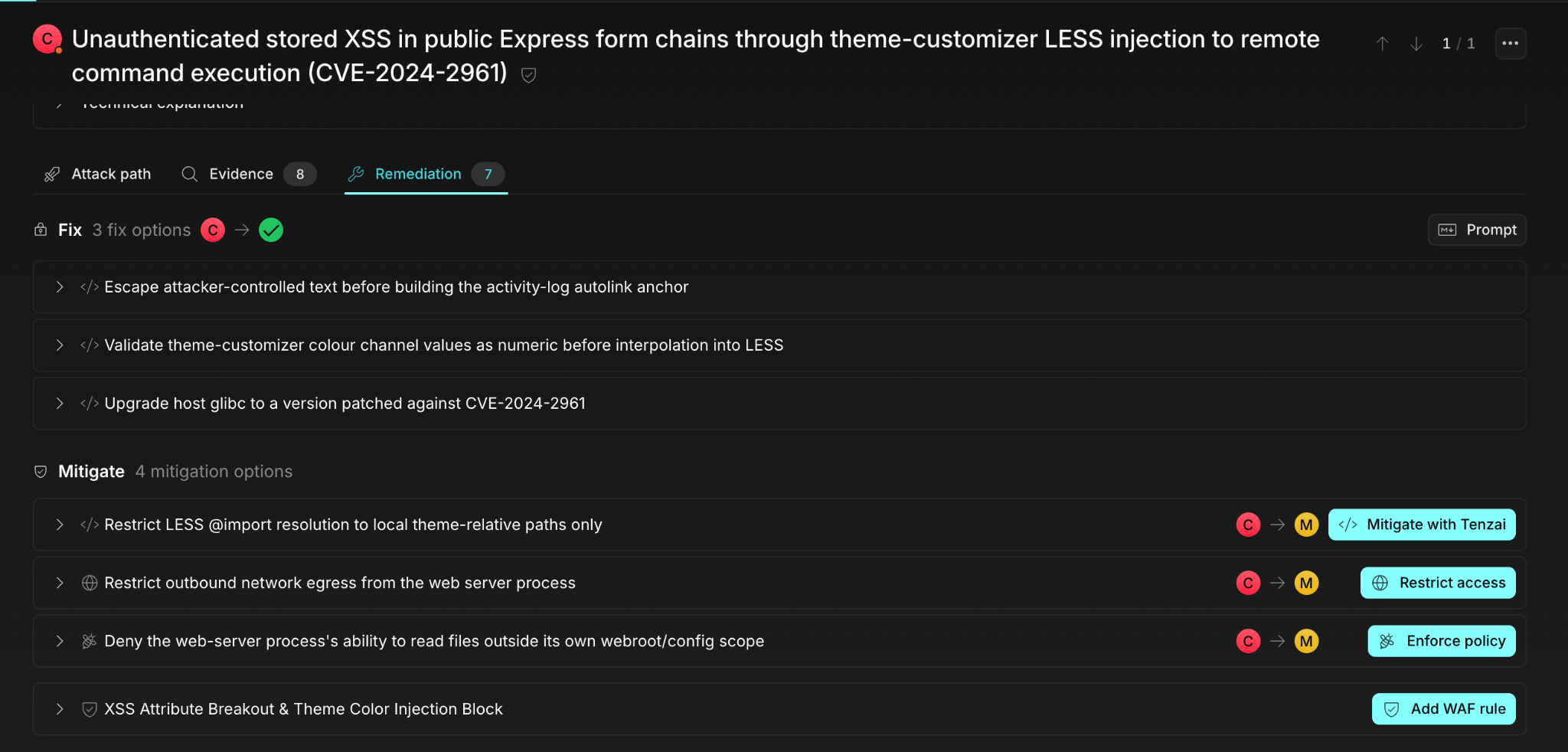
Each option spells out what it blocks, what it leaves open, and what it might break, so you see the tradeoff before you choose.
Clicking a host-based suggestion opens an interactive session with the Tenzai agent:
- Access. If the agent needs access to the affected host, it asks for it, for example an SSH credential stored in the Tenzai vault.
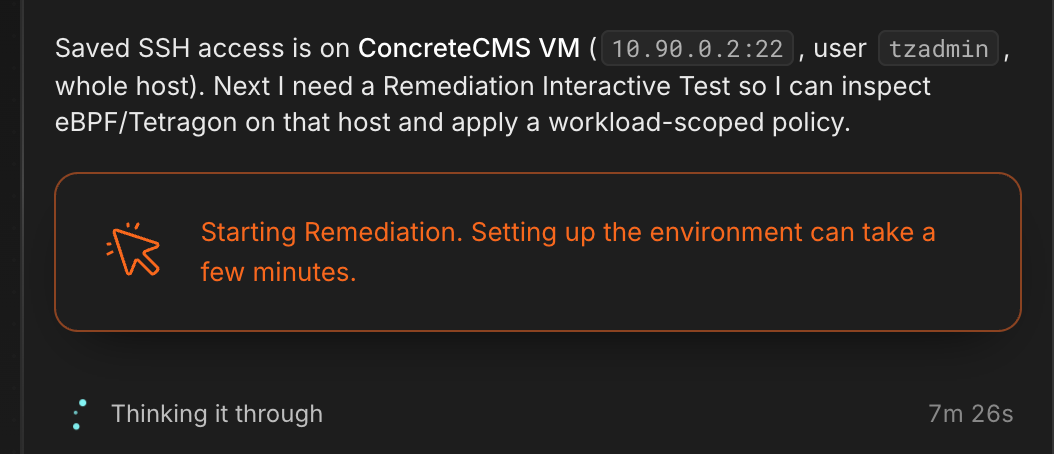
- Host review. The agent connects and reviews the host: OS and kernel, packages, running services and their configuration, and the security controls already in place.
- Plan. Tenzai narrows down the mitigation paths that are actually possible on this host, with the expected effect and tradeoffs of each. If the best option is an eBPF policy and Tetragon isn't installed yet, the agent asks for your approval, then installs it.
- Implementation. You pick the mitigation. The agent implements it, asking for explicit approval before each change. Runtime policies start in observe mode, so the agent can watch the application's normal behavior before it switches to enforcement.
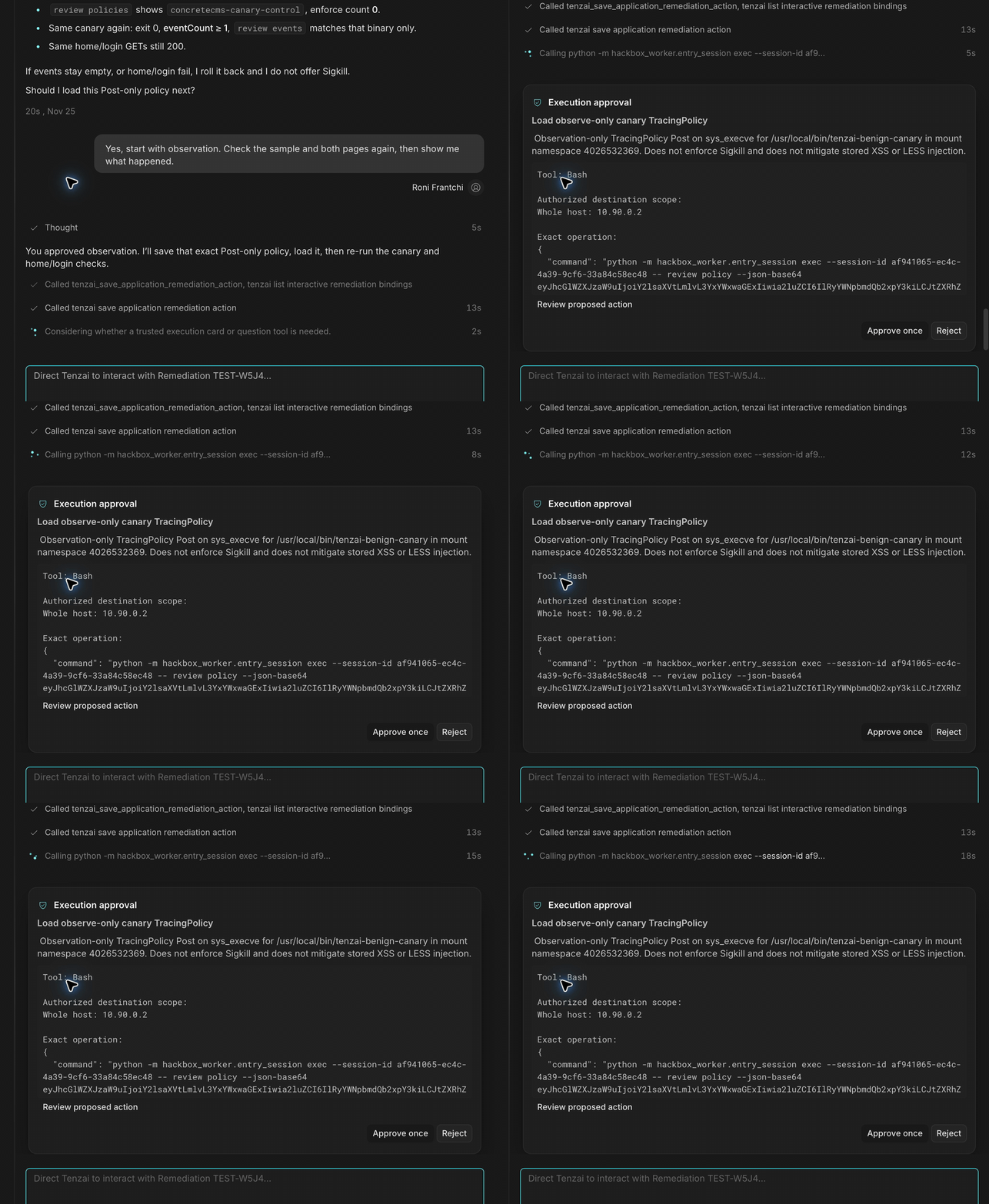
- Validation, both ways. The agent re-runs the original attack to prove the mitigation actually works. Then it checks that nothing else broke, for example by sending legitimate traffic through the application and reviewing the logs.
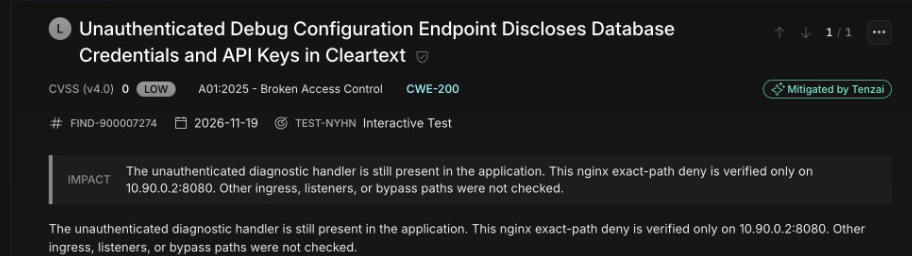
Example 1: ConcreteCMS, contained with eBPF
A few months ago, Tenzai's agents found a chain in ConcreteCMS, a widely used open-source CMS. The chain goes from an unauthenticated form submission to remote code execution: a stored XSS fires in an admin's session, a LESS injection in the theme customizer becomes file read and SSRF, and on glibc 2.39 or older, CVE-2024-2961 turns that into a shell. The LESS injection is tracked as CVE-2026-81910, and ConcreteCMS 9.5.3 fixes it. The full research is on our blog.
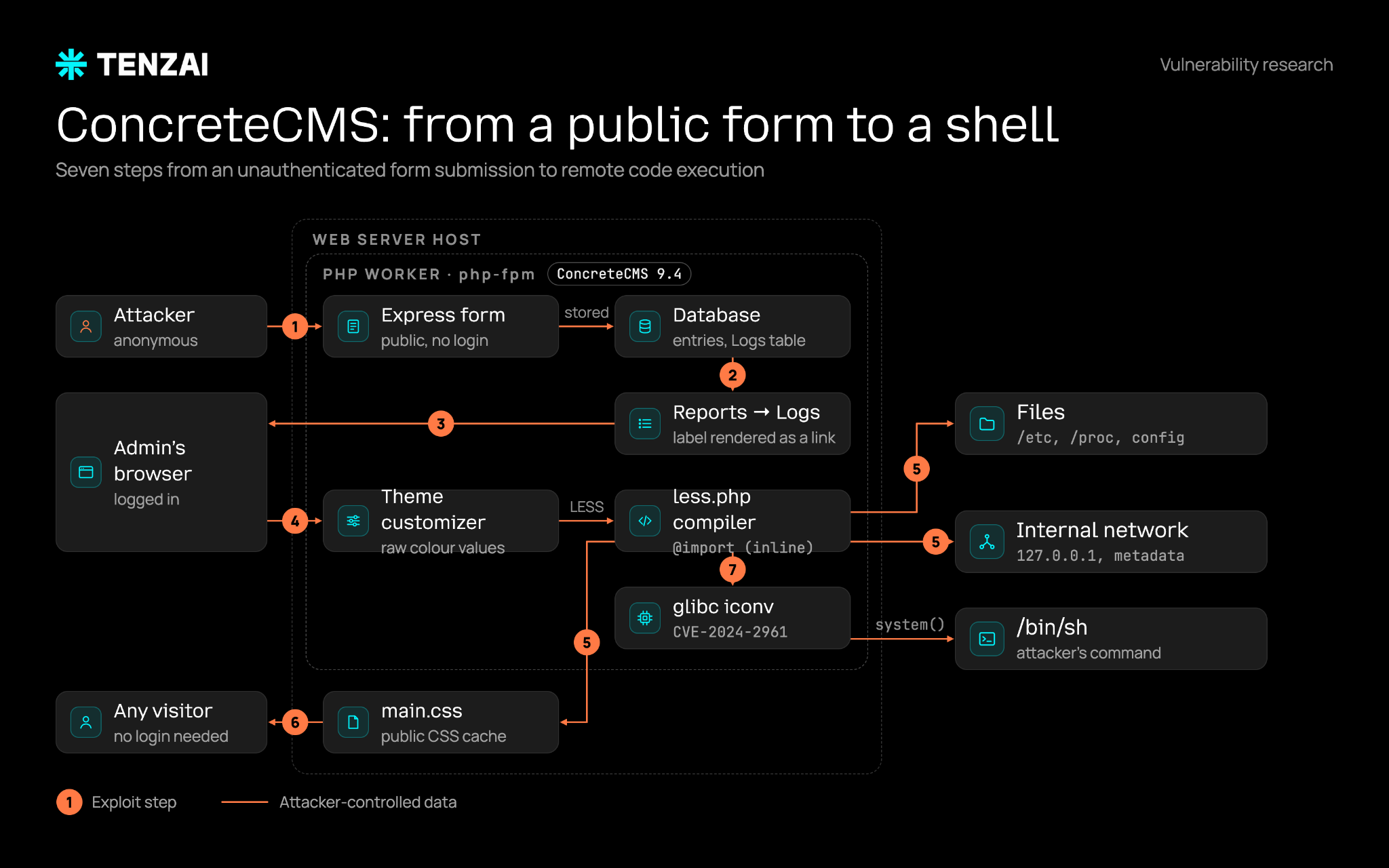
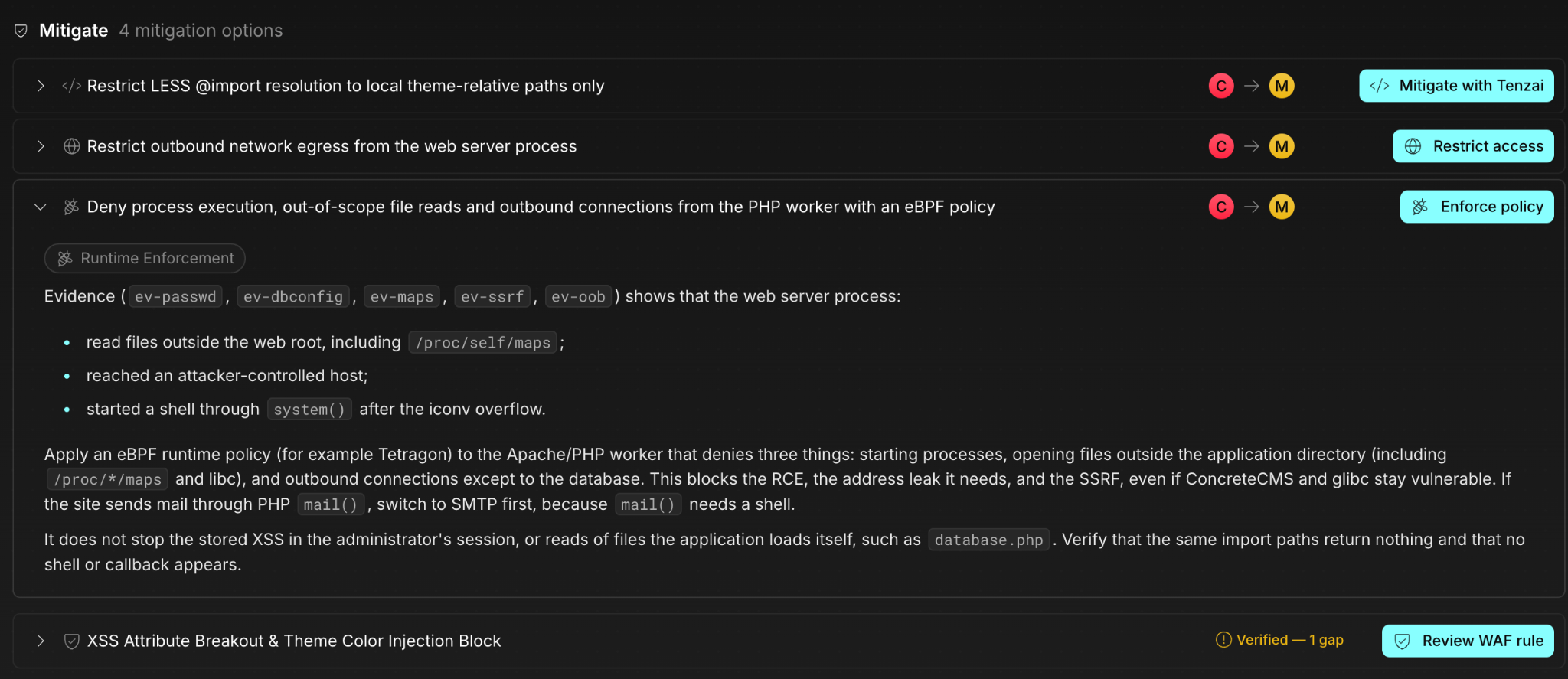
Once the agent detected the chain, it provided multiple options for remediation, including code fixes and mitigation suggestions.
Now, with host-based mitigation, when you click to apply the suggested remediation, the Tenzai agent checks the host: the glibc version, whether the vulnerable iconv charset is loadable, which binary runs PHP, and whether the kernel supports Tetragon enforcement.
You can then guide it safely to verify the finding is still applicable and safely mitigate the issue directly on the host. The agent builds a minimal eBPF policy snippet that protects against any malicious attacker using the RCE to run actual code on the machine, access sensitive files and do any harm.
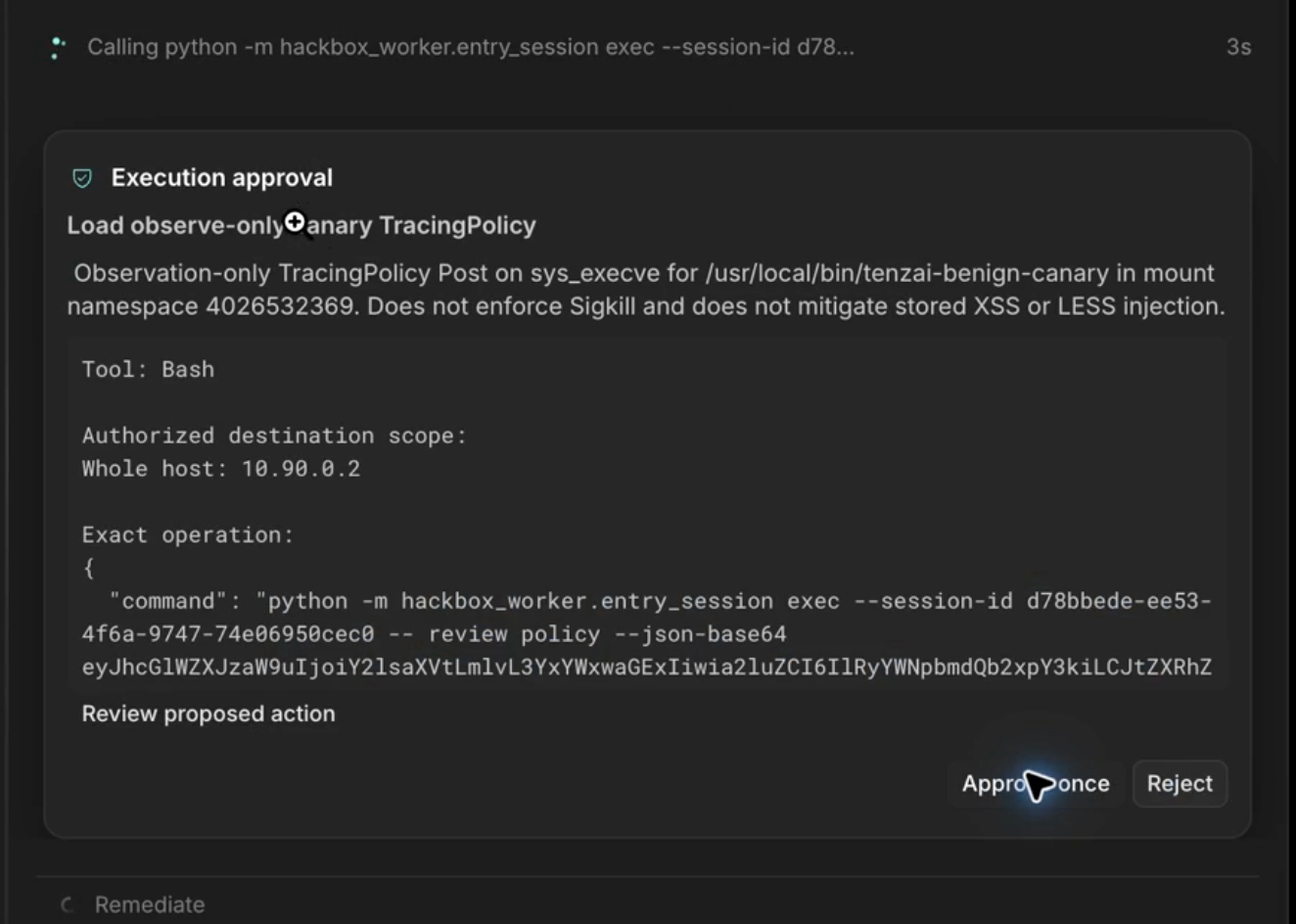
Upgrading to 9.5.3 takes testing and a rollout window, so until then the agent contains the chain: it uses Tetragon and loads three policies scoped to the PHP worker: no shells, no reads of credential or memory-map files, and no connections to cloud metadata or internal addresses. They run in observe mode first, then enforce.
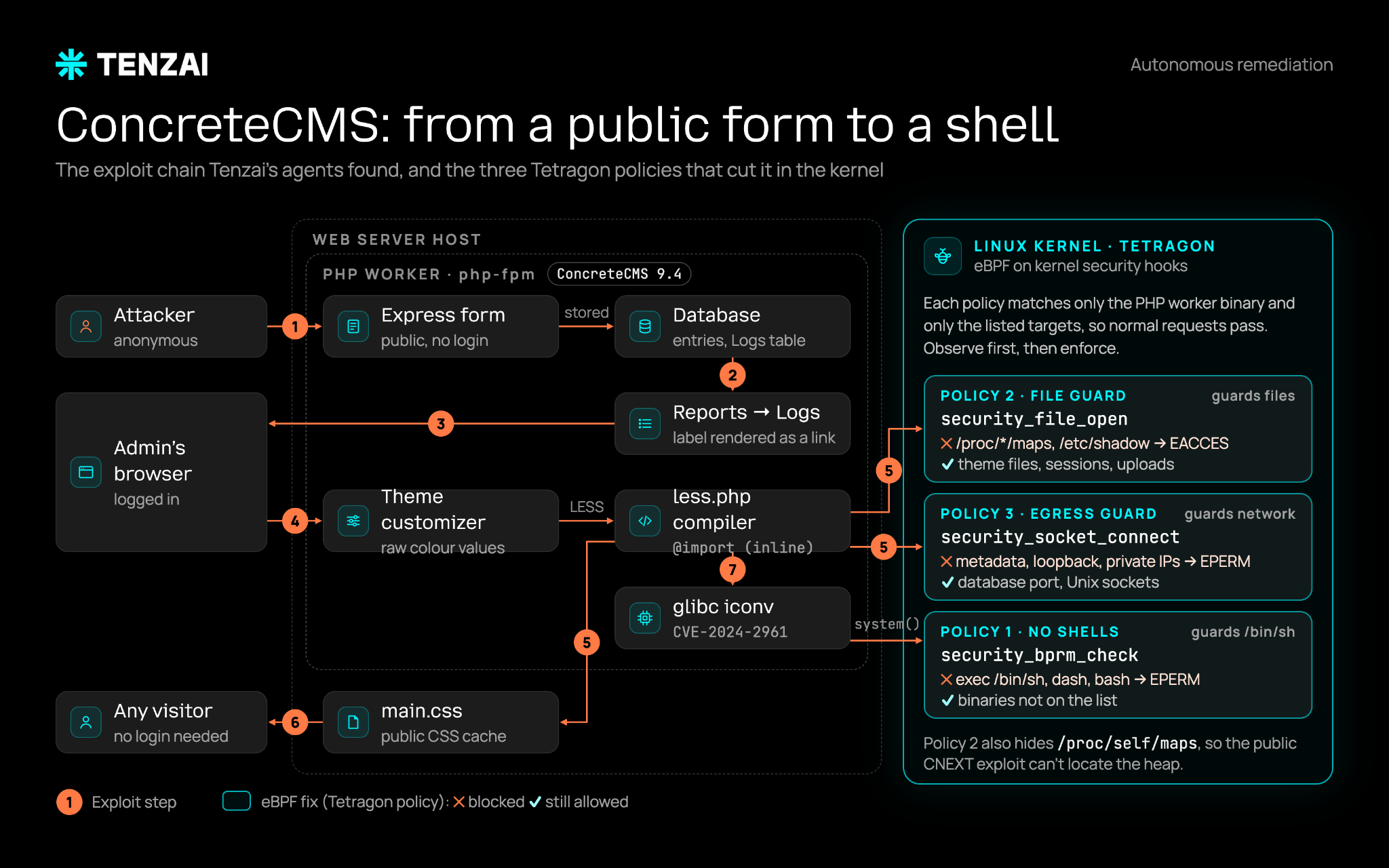
Containment doesn't remove the bugs, so upgrading ConcreteCMS to 9.5.3 and glibc to a patched release stays on the finding as the durable fix.
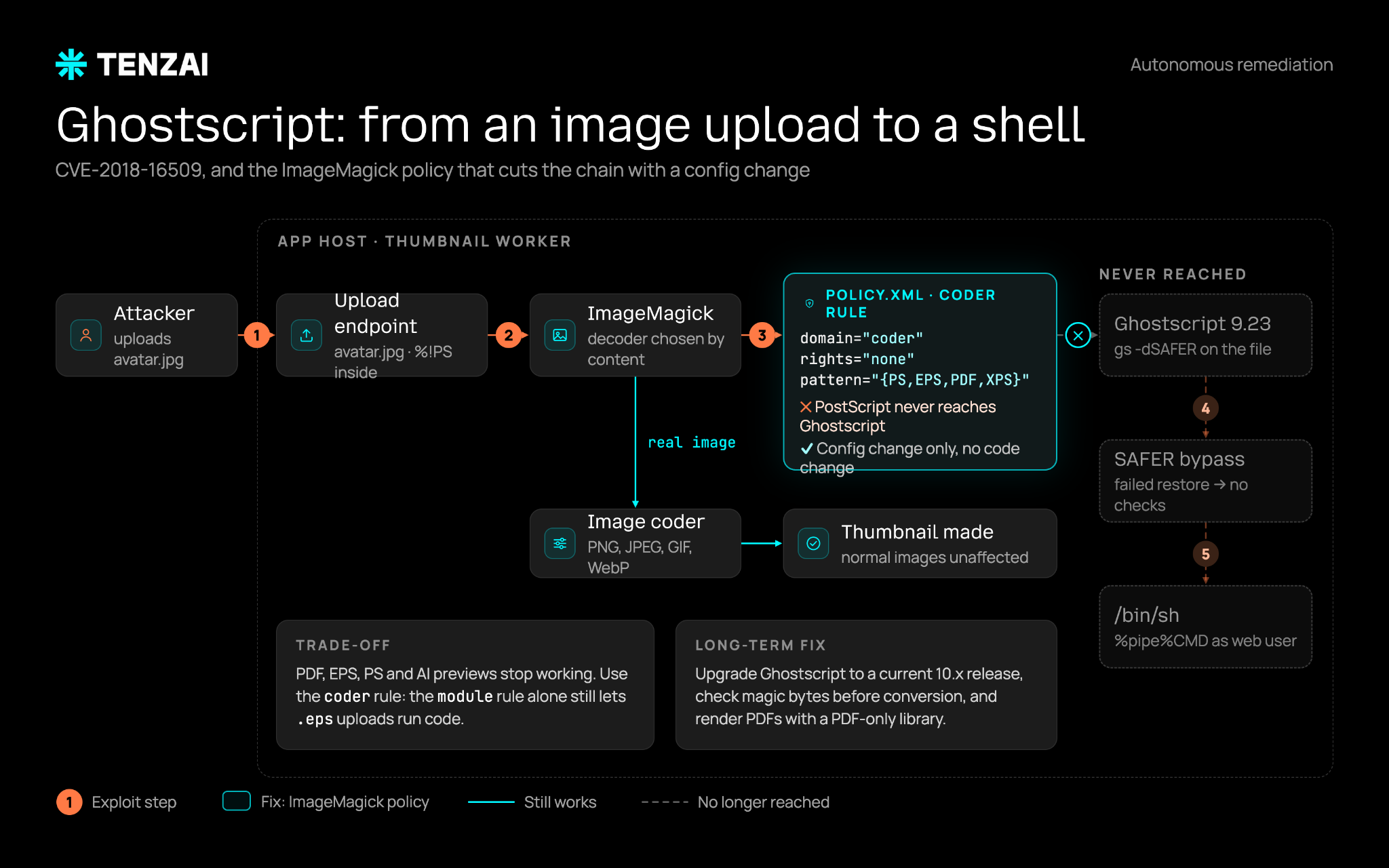
Example 2: Mitigating Ghostscript upload-to-shell with an ImageMagick policy
The second example is a classic upload-to-shell in DocPreview, a document management app. ImageMagick picks the decoder from a file's content, so a PostScript file named avatar.jpg goes to Ghostscript. CVE-2018-16509 escapes Ghostscript's -dSAFER sandbox and runs commands as the web user on versions before 9.24, and the same class keeps recurring, most recently with Upload2Shell (CVE-2026-125396), disclosed by pwn.ai on November 21.
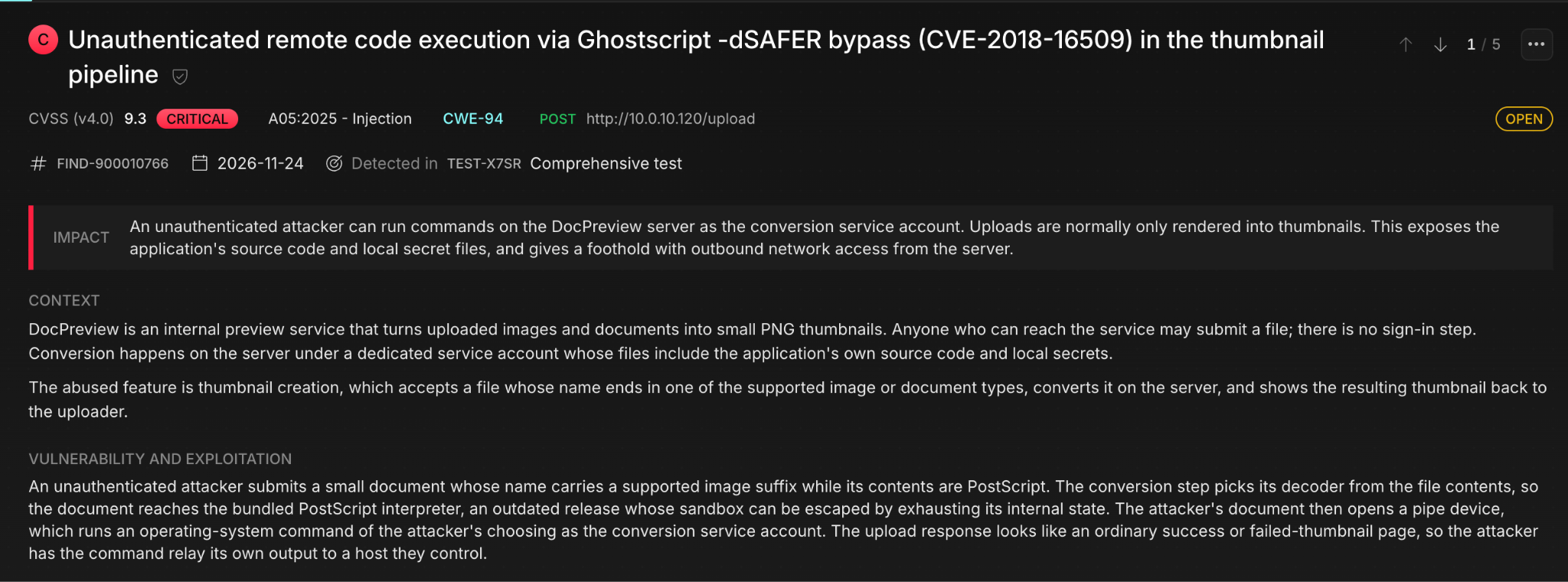
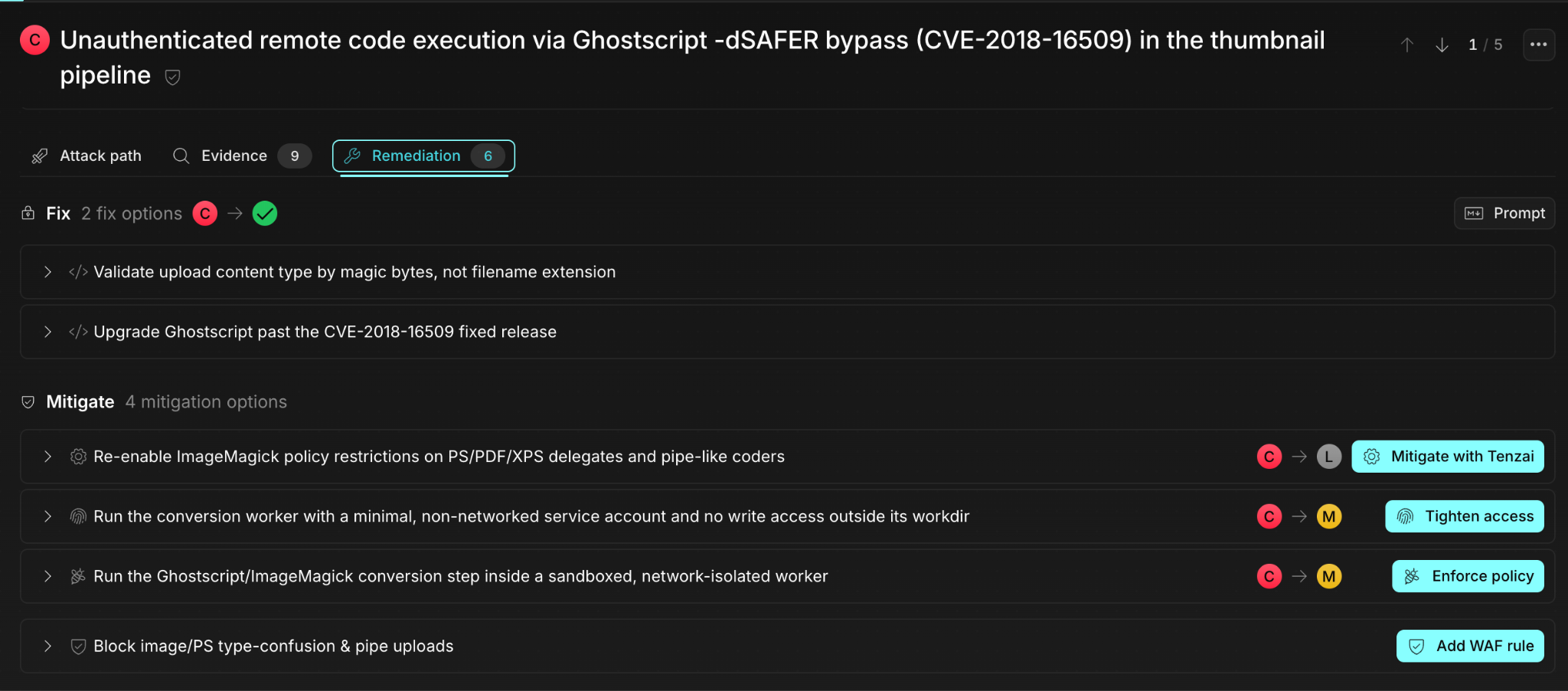
In the suggested remediations the agent proposes upgrading Ghostscript to 10.08.0 or later as the long-term fix, and applies the immediate one: re-enabling a single rule in ImageMagick's policy.xml that stops it from handing PostScript-family input to Ghostscript.
<policy domain="coder" rights="none" pattern="{PS,PS2,PS3,EPS,PDF,XPS}" />The tradeoff: PDF, EPS and PostScript previews stop working, while normal image thumbnails are unaffected. For a service that only needs image thumbnails, that's an acceptable cost. Tenzai host-based mitigation lets you choose the path that fits.
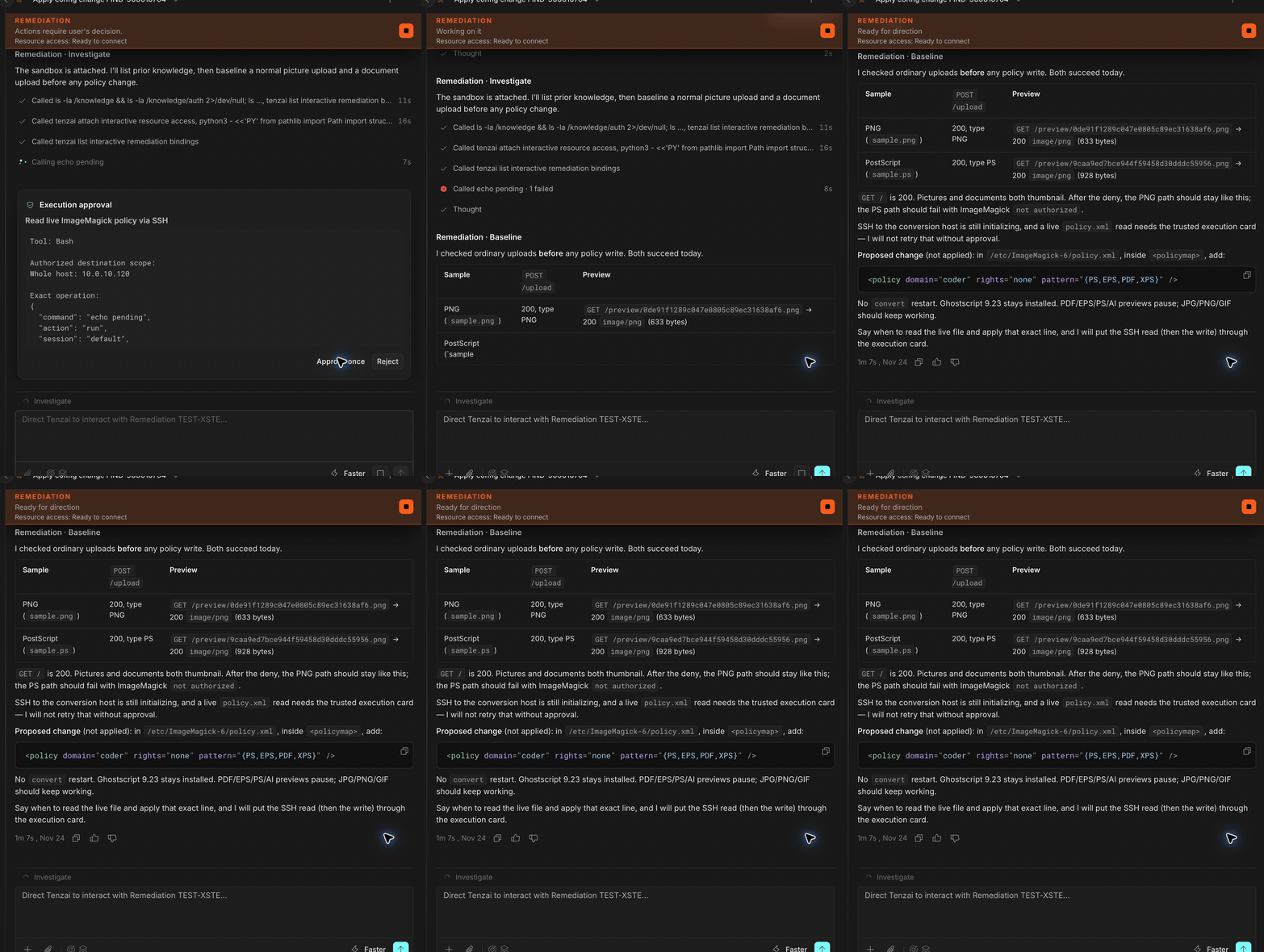
The operator approves the policy change. A harmless PostScript upload that previously rendered now returns 422. A PNG still uploads and renders its thumbnail.
Making offensive security drive real impact
Autonomous mitigation is central to how we think offensive security should drive real impact.
There are many ways to deal with an issue we find, across four domains: code, traffic, host, and identity & cloud configuration. Today we're adding the host, and we'll keep expanding the arsenal. The same agents that prove an attack is possible should help you make sure it no longer is. That's what we build.
Want to see host mitigation in action? Get a demo of Tenzai.
Talk to us. We're listening.
See Tenzai run against an app you own.
Get a DemoMedia inquiries and interviews
[email protected]Hiring elite hackers and more
Open roles